


Dangote, Monopoly Power, and Political Economy of Failure
By Blaise Udunze
Nigeria’s refining crisis is one of the country’s most enduring economic contradictions. Africa’s largest crude oil producer has, for decades, depended on imported refined petroleum products—an outcome as illogical as it is costly. This contradiction has drained foreign exchange, weakened the naira, distorted investment incentives, and hollowed out state institutions, much like the pressures already seen in Nigeria’s fragile macroeconomic environment shaped by insecurity, food inflation, and CBN monetary tightening.
Instead of catalysing industrialisation, Nigeria’s oil wealth became a channel for capital flight, rent-seeking, and institutional decay. The outcome mirrors other policy distortions, including controversial tax reforms raising concerns for workers and businesses.
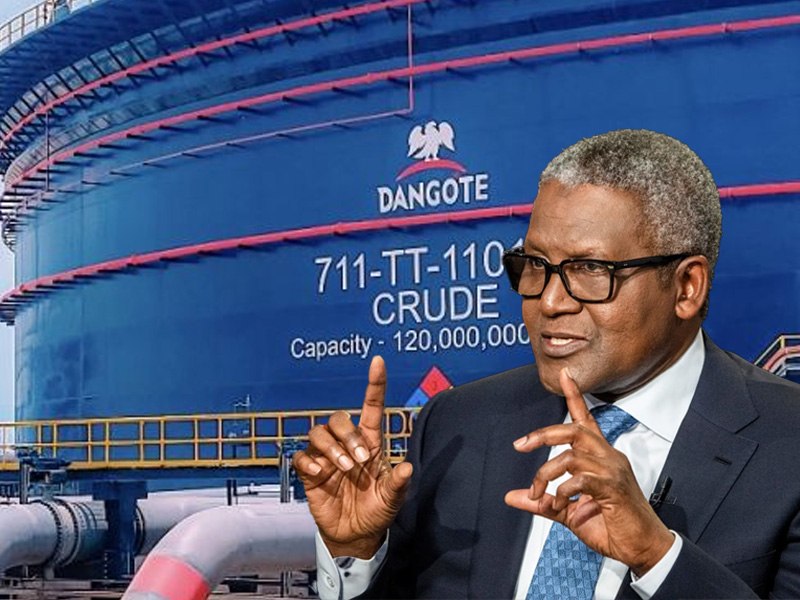
With persistent challenges in refining crude oil locally, the emergence of the Dangote Refinery marks a historic moment. The refinery promises to slash fuel imports, stabilise foreign exchange earnings, ensure domestic fuel availability, and position Nigeria as a regional exporter of refined products—an ambition made more urgent as Nigeria recently earned ₦12.81 trillion from crude oil exports in Q3 2025.
Dangote Refinery symbolises what private capital, technology, and ambition can achieve in Africa after years of fuel queues, subsidy scandals, and reputational damage. Yet Nigerians must pause before unrestrained celebration. Nigeria’s refining problem is not merely about capacity; it is fundamentally about systems.
Without fixing the policy failures and institutional weaknesses that made Dangote an exception rather than the norm, Nigeria risks replacing one failure with another—this time disguised as private-sector success. This concern echoes broader governance debates, including the dangers of mandatory TIN policies that risk financial exclusion.
The Long Silence of Refinery Investments
A troubling question persists: why have global oil majors such as Shell, ExxonMobil, Chevron, Total, and Agip failed to build a major refinery in Nigeria for over four decades? These firms extracted Nigerian crude, sold refined products back to the country, yet avoided domestic refining.
Policy incoherence—not technical incapacity—was the deterrent. Price controls, licensing bottlenecks, subsidy arrears, regulatory uncertainty, and political interference made refining unattractive. Importation, by contrast, delivered quick returns with lower political risk.
Nigeria designed a system that rewarded importers and punished refiners. Dangote succeeded not because the system improved, but because he could withstand its dysfunction through exceptional capital, political access, and risk tolerance. When institutions fail, progress becomes dependent on extraordinary individuals rather than predictable systems—a dangerous precedent.
The Tragedy of NNPC Refineries
Nigeria’s state-owned refineries—Port Harcourt, Warri, and Kaduna—should have filled the gap. Instead, they became symbols of mismanagement. Between 2010 and 2025, an estimated $18–$25 billion (over ₦11 trillion) was spent on turnaround maintenance with negligible output.
This governance failure mirrors inefficiencies across public institutions, where resources are consumed without accountability—unlike structured success stories such as FirstBank’s Elephant Girls qualifying for continental basketball competition, where planning and oversight delivered results.
Where Is BUA?
Dangote is not alone. In 2020, BUA Group announced plans for a 200,000-barrel-per-day refinery. Years later, progress remains uncertain. When multiple large investors struggle to execute, the problem is not ambition but environment.
Nigeria’s upstream and downstream sectors require consistent leadership and regulatory clarity, particularly as figures like Oritsemeyiwa Eyesan take on key roles in Nigeria’s upstream oil sector.
Dangote and the Monopoly Question
Dangote Refinery deserves credit. But scale brings power, and power demands oversight. If importers exit and no competing refineries emerge, Nigeria risks replacing public monopoly with private monopoly—much like past experiences in cement.
Markets thrive on competition. Without it, price manipulation, supply risks, and weakened energy security become real dangers, especially in countries with fragile regulatory institutions.
The Way Forward
Nigeria does not need to weaken Dangote; it needs to multiply Dangotes. The goal should be a competitive refining ecosystem supported by transparent crude allocation, open pipeline access, fair pricing, and strong antitrust enforcement.
The Litmus Test
Nigeria’s refining crisis cannot be solved by one refinery, however large. Dangote Refinery is a turning point only if embedded within systemic reform. Otherwise, Nigeria risks trading one dependency for another.
The real test is not whether Nigeria can refine fuel, but whether it can build fair, open, and resilient institutions that serve the public interest. In refining—as in democracy—excessive concentration of power is dangerous. Competition remains the strongest safeguard.
Blaise, a journalist and PR professional, writes from Lagos and can be reached via blaise.udunze@gmail.com