





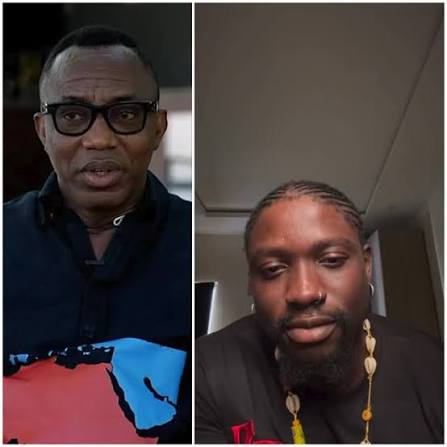
The ongoing conversation surrounding Omoyele Sowore and VeryDarkMan has grown beyond a simple clash of personalities. It has become a reflection of a deeper question in Nigerian society: what truly defines activism, and who gets to wear that label?
For many Nigerians, activism has traditionally been associated with sacrifice, consistency, and a willingness to challenge systems of power over long periods of time. In this regard, Sowore represents a model that has been tested across years of engagement. His voice has been present in conversations about governance, human rights, and accountability long before social media became a dominant force. His approach is rooted in persistence raising issues, mobilizing attention, and often putting himself at personal risk in the process.
Over the years, he has come to symbolize resistance for people who feel unheard. Whether confronting authority or speaking on behalf of ordinary citizens, his advocacy has maintained a certain structure. It is not just about calling out a problem; it is about pushing for systemic change.
That distinction matters, especially in a country where many issues are deeply embedded and cannot be solved overnight. His style may not always be loud or trending, but it has carried a sense of direction that many supporters find reassuring.
On the other side of the conversation is VeryDarkMan, a figure who rose rapidly through the power of social media. His presence is bold, immediate, and often unfiltered. He speaks directly to an audience that is tired of silence and slow responses. In a digital age where attention moves quickly, his style fits the moment. He reacts fast, calls out perceived wrongdoing, and draws public focus to issues that might otherwise go unnoticed.
There is no denying that this approach has influence. Many people see him as fearless, someone who is willing to say what others will not. His supporters argue that without voices like his, certain conversations would never reach the public eye. In a society where frustration runs deep, that kind of energy can feel necessary.
However, the criticism surrounding him is just as strong. A recurring concern is that while he brings attention to issues, the outcomes are not always clear. Cases can rise quickly in the public eye and then fade without resolution. This creates a sense that attention is being redirected rather than problems being solved. For some observers, this pattern raises questions about whether visibility alone is enough to qualify as meaningful activism.
Another point of debate lies in the tone and method of engagement. Social media thrives on intensity, and that intensity can sometimes blur the line between advocacy and controversy. When discussions become heated or personal, the original issue risks being overshadowed. What begins as a call for accountability can turn into a cycle of reactions, counter-reactions, and distractions. In such moments, it becomes difficult to separate the message from the noise.
This is where the contrast between the two figures becomes most visible. Sowore’s approach leans toward process and principle. It emphasizes patience, structure, and a focus on long-term impact. VeryDarkMan’s approach leans toward immediacy and pressure. It prioritizes quick exposure and public reaction. Both methods have value, but they operate on very different timelines and expectations.
The tension between them highlights a larger shift in how activism is perceived. In the past, influence was built over time through consistent effort and engagement with institutions. Today, influence can be built almost overnight through digital platforms. This shift has changed not only who gets heard, but also how issues are addressed.
Yet, speed comes with its own challenges. When everything happens quickly, there is less room for careful verification, deeper investigation, and sustained follow-up. The result can be a cycle where new issues constantly replace old ones, leaving many unresolved. This is one of the key criticisms directed at fast-paced, social media-driven advocacy, it can create momentum without necessarily creating solutions.
At the same time, traditional activism is not without its limitations. It can be slow, sometimes frustratingly so.
Change does not always come easily, and progress can feel distant. For younger audiences especially, this pace can seem disconnected from the urgency of everyday struggles. This is why figures like VeryDarkMan resonate they reflect a desire for immediate action and visible impact.
The real issue, then, is not simply about choosing one approach over the other. It is about understanding the balance between them. Exposure without resolution can lead to fatigue. Structure without visibility can lead to silence. Effective advocacy may require both the ability to draw attention and the discipline to follow through.
In evaluating the current debate, it is also important to be fair. Labels like “activist” carry weight, and people define them differently. For some, activism is about intention speaking up and challenging wrongdoing. For others, it is about outcomes creating measurable change and lasting impact. These definitions do not always align, which is why disagreements like this arise.
What remains clear is that credibility is built over time. Consistency, accountability, and results all play a role in shaping how individuals are perceived. While rapid influence can open doors, sustained trust depends on what happens after the spotlight fades.
The conversation between Sowore and VeryDarkMan ultimately reflects a society in transition. Nigeria, like many countries, is navigating the intersection of traditional structures and digital disruption. Voices are louder, platforms are wider, and expectations are higher. In this environment, the meaning of activism is being redefined in real time.
As the debate continues, it may be more useful to move away from personal comparisons and focus instead on impact. Which actions lead to real change? Which methods empower people beyond the moment? Which voices remain consistent when attention shifts elsewhere?
These are the questions that matter. Because in the end, activism is not just about being heard, it is about making a difference that lasts.

