

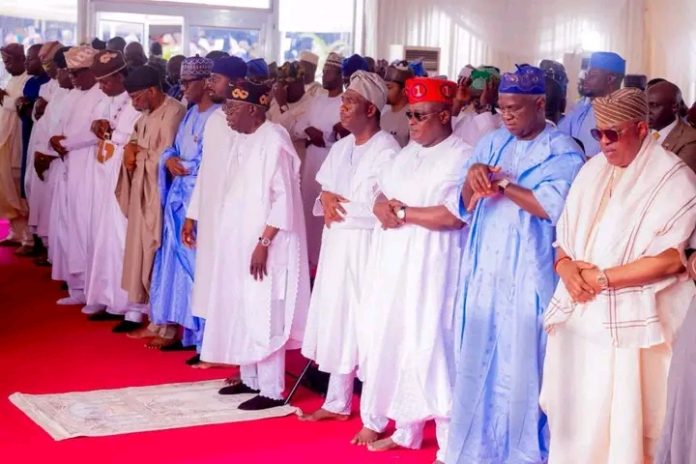
President Bola Ahmed Tinubu on Wednesday joined Muslim faithful at Dodan Barracks in Lagos for the observance of Eid prayers, as millions of Muslims across Nigeria marked the festive season with worship, reflection, and acts of charity.
The Eid gathering attracted worshippers from different parts of Lagos and featured the presence of several senior government officials, political associates, and community leaders who came together for the important religious occasion. The atmosphere around Dodan Barracks was calm and celebratory as security personnel, religious leaders, and residents participated in the prayers marking one of the most significant periods in the Islamic calendar.
Among the dignitaries who accompanied the President were his Chief of Staff, Femi Gbajabiamila; the National Security Adviser, Nuhu Ribadu; former Lagos State Governor, Babatunde Fashola; Speaker of the Lagos State House of Assembly, Mudashiru Obasa; and Lagos State Deputy Governor, Obafemi Hamzat.
The gathering reflected the continued importance of religious unity and national togetherness during festive celebrations in Nigeria. Worshippers who attended the prayers expressed gratitude for peace, stability, and the opportunity to celebrate Eid with family members and loved ones. Many also used the occasion to offer prayers for the country’s progress, improved security, economic growth, and unity among citizens.
President Tinubu’s participation in the Eid prayers highlighted his administration’s ongoing engagement with religious communities and traditional events across the nation. Since assuming office, the President has consistently emphasized national cohesion and peaceful coexistence among Nigerians regardless of tribe, religion, or political affiliation.
Religious leaders at the prayer ground encouraged Muslims to uphold the values of sacrifice, discipline, compassion, and generosity, which are central teachings associated with the Eid celebration. They also urged Nigerians to continue supporting one another during challenging times while promoting tolerance and peaceful living in their communities.
The Eid season traditionally witnesses increased charitable activities, with many Muslim families providing food, clothing, and financial assistance to vulnerable individuals and less privileged members of society. Across Lagos and other parts of the country, residents celebrated the occasion through communal prayers, visits to loved ones, and the sharing of meals.
Security presence around Dodan Barracks remained noticeable throughout the event as officials ensured orderliness and smooth movement of worshippers attending the prayers. Traffic management personnel were also deployed to control vehicular movement around the area to prevent congestion during and after the gathering.
Political observers noted that the appearance of several influential figures alongside the President underscored the significance attached to major religious occasions in Nigeria’s political landscape. Public celebrations such as Eid often serve as opportunities for leaders to connect directly with citizens and reinforce messages of unity and national solidarity.
The President exchanged greetings with worshippers and dignitaries after the prayers, while many attendees took photographs and interacted with public officials present at the venue. Supporters and residents around the prayer ground also welcomed the President warmly as the event concluded peacefully.
In many parts of the country, Eid celebrations continued with visits to family members, community feasts, and recreational activities. Markets and commercial centers in Lagos witnessed increased movement as residents prepared meals and purchased festive items for the holiday period.
The observance of Eid in Nigeria remains one of the nation’s most widely celebrated religious events, bringing together people from various social and economic backgrounds. The annual celebration also serves as a reminder of the values of obedience, sacrifice, kindness, and devotion associated with the Islamic faith.
For many Nigerians, the presence of national leaders at religious gatherings symbolizes solidarity with citizens and recognition of the cultural and spiritual importance of such occasions. Analysts believe public participation in faith-based events can also strengthen trust and communication between government officials and local communities.
As celebrations continue nationwide, many citizens are hopeful that the spirit of Eid will inspire greater unity, compassion, and cooperation across the country. Religious leaders have continued calling on Nigerians to pray for peace, economic stability, and progress while encouraging citizens to support initiatives aimed at national development.
The gathering at Dodan Barracks ended on a peaceful note, with worshippers departing gradually after exchanging greetings and prayers for the nation’s future. The event added to the series of Eid activities taking place across Nigeria as Muslims celebrated with renewed faith and hope for better days ahead.