





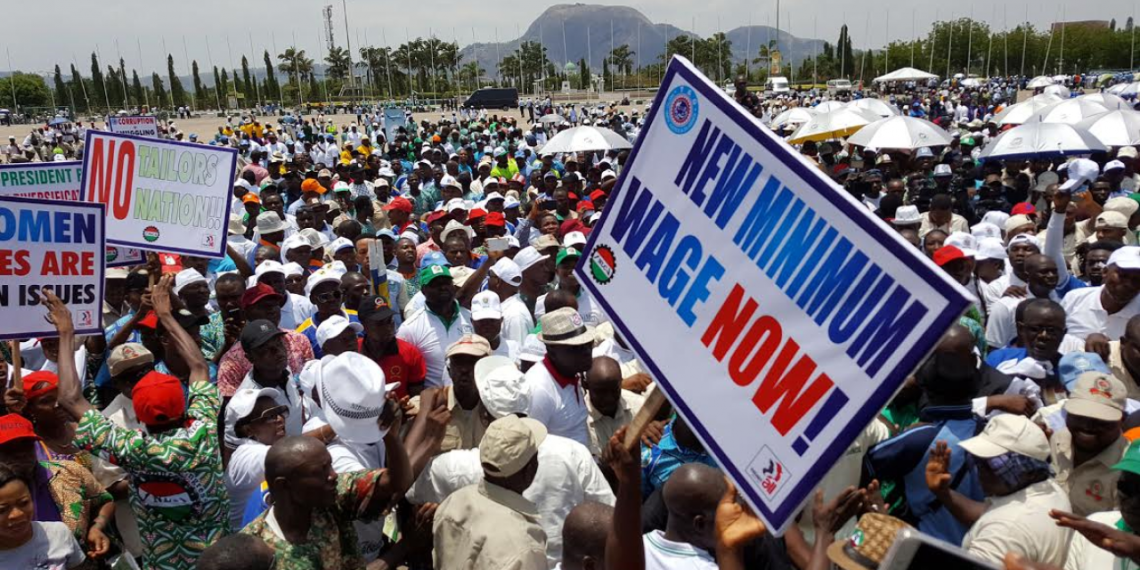
The face-off between the organised Labour and the federal government over the new minimum is not having a lead way, as the two sides are yet to reach a consensus on how much the new minimum wage should be.
Despite the series of meetings the tripartite committee set up by the federal government had with the organised Labour, the solution is still out of sight.
The tripartite committee has submitted its report to the federal government, more so; president Bola Tinubu had instructed the Minister of Finance Wale Edun, to make provision for the new minimum wage by sending a letter to the National Assembly so that the new minimum wage can be accommodated in the supplementary budget that would be forwarded to the national assembly.
The question to ask is, what would be the modality for the provision of the new wage, since the two contending forces have not met a compromise, would it be an envisioned wage in tandem with the demands of the labour sector or federal government using her discretion, which has been subjected to probe by the state governors.
At the last meeting between organised Labour, the federal government insisted on paying N62,000 as a new minimum wage, but Labour, however, proposed ₦250,000, which is a shift from its earlier ₦494,000.
After submitting the tripartite report, President Bola Tinubu is expected to send an executive bill to the National Assembly for legislative action.
Read Also: Minimum Wage: You Can’t Dictate What To Pay, NLC Replies Govs
Despite the deliberations, the Nigeria Governors’ Forum (NGF) said that the earlier proposal of N60,000 is unsustainable.
According to the governors, many states won’t undertake other projects if the proposal goes through.
Speaking in the same vein, the Southern Governors want each state to determine the new minimum wage she can afford. Rising from their meeting, held in Abeokuta, the 17 Governors from the Southern part of Nigeria under the aegis of the Southern Governors Forum advocated that each state should be allowed to negotiate a new minimum wage they can pay with the labour unions.
This was contained in a communique issued at the end of their meeting.
“The Forum discussed the minimum wage issues demanded by labour and unanimously agreed that the minimum wage should be reflective of the cost of living and ability to pay, and each State be allowed to negotiate their minimum wage,” the communique partly read.
Labour, on its part, noted that it would not accept the N62,000 proposed by the Federal government; speaking on the development, Assistant General Secretary of the Nigeria Labour Congress (NLC) Chris Onyeka insisted on ₦250,000 as the minimum wage.
“We have never considered accepting ₦62,000 or any other wage that we know is below what we know can take Nigerian workers home. We will not negotiate a starvation wage,” he said on Channels Television’s program the morning brief.
He added “We have never contemplated ₦100,000 let alone of ₦62,000. We are still at ₦250,000, that is where we are, and that is what we considered enough concession to the government and the other social partners in this particular situation. We are not just driven by frivolities but the realities of the market place; realities of things we buy every day: bag of rice, yam, garri, and all of that.” He said.
The governors had recently expressed concerns about the federal government’s proposed N60,000 minimum wage for workers, warning that it is unsustainable.
They argued that implementing such a wage would result in many states allocating their entire monthly federation account disbursements solely to salary payments.
They urged the tripartite committee to agree on a fair and sustainable minimum wage.
Reacting to the proposal made by the southern governors that each state should pay a new minimum wage it can afford, the umbrella body for labour unions in the country, Nigeria Labour Congress NLC faulted the comments credited to the governors that states should determine their minimum wage in their domains.
“This notion is not only dictatorial but also undermines the very essence as well as the model adopted for creating a national minimum wage in Nigeria,” the NLC said in a statement issued by its Head of Information and Public Affairs, Benson Upah.
NLC says the governors’ move threatens the welfare of Nigerian workers and the national economy.
“The concept of a national minimum wage is not arbitrary. It represents a national wage floor, a baseline below which no worker in the law should be paid.
“This threshold is a collective agreement that ensures a minimum standard of living for every worker in the law. The governors’ demand to unilaterally determine the minimum wage negates this principle and threatens the welfare of Nigerian workers and the national economy,” the union said
“It is important to remind the governors that the national minimum wage is not synonymous with the individual pay structures of the states which they implement religiously, reflecting their unique financial capabilities and circumstances.
This diversity in pay structures underscores the flexibility within the system, allowing states to reward their workers in alignment with their financial realities.” The labour union said.
The organised Labour have suspended their following line of action, pending when they will receive the amount President Tinubu will announce as minimum wage. The president had assured the labour union that the federal government would pay what it can afford above the N62,000 minimum wage.
But, there was a twist to the development as the federal government stepped down the new minimum wage debate at the Federal Executive Council, arguing that the president needed to engage in wider consultation before it agreed on a result.
Briefing journalists on the development, the Information minister, Mohammed Idris, disclosed to State House correspondents that after President Tinubu presided over the Federal Executive Council (FEC) meeting at the Presidential Villa, Abuja, and a report from the tripartite committee set up to resolve the issue had been submitted to him, the complexity of the issue necessitates further discussions.
The minister explained that the Federal Executive Committee had deliberated on the matter but ultimately decided to step it down.
The minister said that the decision to step down discussion on the new minimum wage ensures that all stakeholders, including state governments and private sector representatives, have an opportunity to provide input.
He reiterated that the national minimum wage affects all levels of government and the private sector, making it crucial to consider various perspectives before moving forward
He said, “That memo was stepped down to enable Mr President to consult further, especially with the state governors and the organised private sector, before he makes a presentation to the National Assembly before an executive bill is presented to the National Assembly.
“So I want to state that on the new national minimum wage, Mr. President is going to consult further so that he can have an informed position because the new national minimum wage, like I said, is not just an issue of the federal government:
It affects the state governments, the local governments, and the organised private sector, which is why it is called the national minimum wage. It’s not just an affair of the federal government.”
It will be recalled that organised Labour had, on June 3, 2024, embarked on a two-day strike over the failure of the tripartite committee to agree on a new minimum wage and for a reversal of the electricity tariff hike.
Whenever a new minimum wage is agreed upon, the implementation will take effect from May 2024.
However, organised Labour has hinted that the new national minimum wage is expected to be finalised by early August 2024.
The president of the Trade Union Congress of Nigeria (TUC), Comrade Festus Osifo, gave a hint when the labour centre received officials from the Kogi State government led by the special adviser on labour matters to the state governor, Usman Ododo, Comrade Onuh Edoka, in Abuja.
The TUC president called for urgency in updating the minimum wage to address Nigerian workers’ economic challenges, particularly in light of rising economic challenges.
Osifo said that the TUC and the Nigeria Labour Congress (NLC) were working diligently to ensure that the new minimum wage bill progressed swiftly through the National Assembly and received presidential assent by the end of July or early August.
The labour leader called on state governments to be prepared for the new wage implementation, citing Nasarawa State’s proactive steps in setting aside funds to meet future obligations.
Osifo expressed the readiness of TUC to monitor state-by-state implementation once the new wage act is passed.
He urged Kogi State and other states to prioritise the new minimum wage amidst revenue challenges.
He said, “What we are working on, from both labour centres, is that before the end of July, we should have a new minimum wage that must have passed through the processes and been assented to by the president so that the plight of the workers will improve much more.
“We know that, by the grace of God, the new minimum wage act should be in place by the end of July, at most early August. This will significantly improve the plight of workers, enabling them to afford basic necessities despite skyrocketing inflation.
“Prompt salary payments not only benefit workers but also stimulate the state’s economy as workers spend their earnings on goods and services, driving economic growth; therefore, we encourage continuous prompt payment of salaries and timely implementation of the new minimum wage.”
The issue of minimum wage is a precarious decision to take, which justifies why President Tinubu insisted on embarking on wider consultation before arriving at a new minimum wage.
The state governors are not alone in fear of inability to afford the new minimum wage
The Organised Private Sector (OPS) and entrepreneurs nationwide have kicked against the proposed National Minimum Wages between the federal government and the Labour.
Read Also: One Dead In Third Mainland Bridge Ghastly Accident
Their concern is the new national minimum wage’s impact on their businesses when it finally becomes a law.
The Organised Private Sector (OPS) has expressed concern that increasing the minimum wage beyond N62,000 may lead to downsizing.
According to the Director General of Nigeria Employers Consultative Association NECA, Adeyemi-Smatt Oyerinde sounded a note of warning against overstretching the employers of Labour in the Organised Private Sector saying they have already been pushed to the wall by the current economic crunch.
According to Oyerinde, the current economic situation has made the negotiations much more difficult for everyone.
He noted that ‘it should be emphasised that what the Committee was mandated to discuss was a new national minimum wage, not a general salary increase.’
Lamenting that many businesses, following their inability to weather the storm, have already left the country, these negotiations, he added, could be another condition that would affect them.
To him, “In the present circumstances and even before the inauguration of the Tripartite Committee, many businesses have either folded, relocated or reduced their operational capacity, with consequential effect in job security.
“Thus, the private sector factored in those indices before it agreed to bend backward and made the N62,000 offer. Any figure beyond this will definitely have a consequential effect on job security.
“As far as we are concerned, the Tripartite Committee has completed its assignment by submitting the report to the Federal government. We are waiting on the President and Commander-in-Chief to do the needful.”
Minding the high cost of living and inflation rate, which has skyrocketed, the believe is that further salary increase will add to the burden of Nigerians because it will further jack up the inflation rate and erode the value of the naira the more.
The feeling in some quarters is that, rather than talk of wage increment, Labour should impress it on the government to reduce prices of goods and services, either by regulating the prices or cushioning the effect of increased prices on the masses.
Whatever amount the federal government approves as a new minimum wage, labour should reason with the organised private sector and state governors because throwing the nation into another round of protest will have a devastating effect on the economy of Nigeria.

