






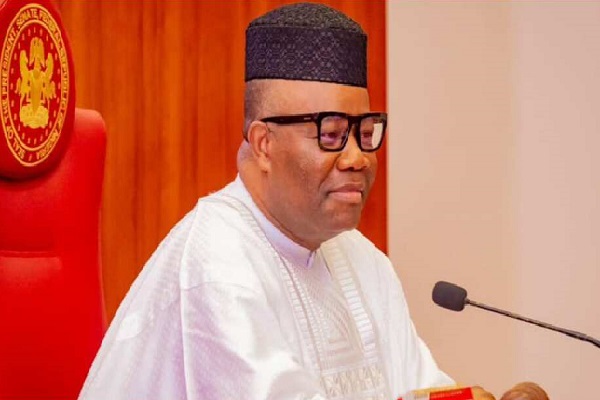
Senate President Godswill Akpabio has criticized Nigerians for demanding better infrastructure while resisting taxation, calling for a more responsible approach to funding national development.
Speaking at a two-day public hearing on the Tax Reform Bills, Akpabio highlighted the paradox of citizens expecting high-quality public services without contributing adequately through taxes. He stressed that while the government is committed to improving the country’s infrastructure, taxation remains the most sustainable way to fund these improvements.
“Tax evasion is widespread in Nigeria, from market traders to high-earning professionals,” he noted, adding that the informal sector, which constitutes a significant portion of the economy, largely operates outside the tax system. Even in the formal sector, many businesses underreport their earnings to minimize tax obligations.
Akpabio acknowledged the frustrations surrounding Nigeria’s complex and inconsistent tax policies, where businesses face multiple levies from federal, state, and local governments, often without clear accountability for how revenues are spent. He warned that excessive taxation without proper management could discourage investment and economic growth.
Despite these challenges, he pointed out that Nigerians continue to demand quality roads, uninterrupted electricity, well-equipped hospitals, and improved education—services that require significant funding. “Taxation should not be seen as a punishment but as a civic duty necessary for national development,” he emphasized.
He also addressed concerns about the fair distribution of tax revenue, citing cases where companies based in one state but operating in another do not contribute enough to the latter’s economy. “Breweries in Ogun State pay most of their taxes in Lagos because their headquarters are there. This imbalance must be addressed,” he stated.
The Tax Reform Bills under discussion aim to simplify the tax system by reducing duplication, lowering collection costs, and introducing digital tax systems to improve transparency and accountability. As discussions continue, stakeholders—including businesses, tax professionals, and civil society organizations—are expected to contribute to shaping a fairer and more efficient tax framework.
Akpabio concluded by urging Nigerians to embrace taxation as a tool for national progress, stating that while the government must ensure accountability in public spending, citizens must also fulfill their obligations by paying taxes. The fundamental question, he said, remains: Can Nigerians demand good governance without being willing to contribute financially?

