

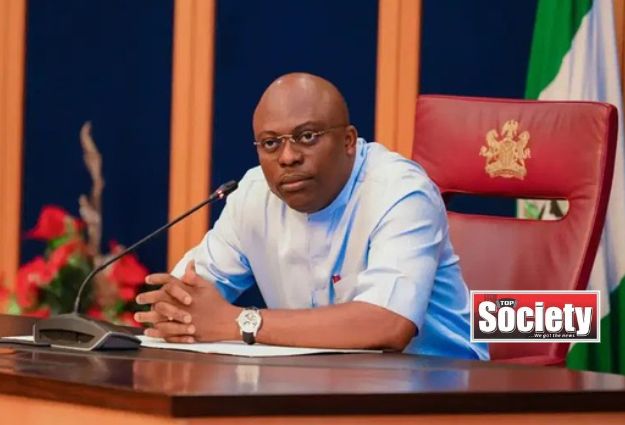
Governor Siminalayi Fubara’s brief appearance before the All Progressives Congress screening panel in Abuja has ignited fresh political speculation, with his silent departure fueling intense conversations about his political future and Rivers State’s governorship race ahead of 2027.
The governor arrived at the screening venue under tight security, accompanied by a small team of aides and close political associates. Observers at the venue described the atmosphere as calm but noticeably tense as party stakeholders and journalists waited for signs of what many expected would be a politically defining moment.
Unlike many high-profile political screenings where aspirants seize the opportunity to reassure supporters and project confidence before the cameras, Fubara chose a different approach. After a short meeting with members of the screening committee, he quietly exited the venue without speaking to journalists or acknowledging questions from the waiting press.
That silence has since become the loudest message of the day.
Political observers immediately began interpreting the governor’s unusual conduct as a possible signal of deeper political complexities unfolding behind closed doors. For weeks, discussions surrounding Rivers State politics have centered on uncertainty over who will control the political machinery leading into the 2027 governorship election.
Fubara’s political standing has remained under intense scrutiny following months of strained relations with key power brokers in Rivers politics. While he has continued to project calm leadership in public, analysts believe internal political realignments may be shaping critical decisions ahead of the next electoral cycle.
The screening itself was expected to provide clarity about the governor’s ambitions and standing within the party structure. Instead, his refusal to speak has left supporters and critics drawing their own conclusions.
Within Rivers political circles, opinions remain sharply divided.
Supporters of the governor insist his silence reflects discipline and strategic restraint rather than uncertainty. According to allies, Fubara has consistently avoided public political confrontations and prefers to allow official processes to unfold without media drama.
They argue that reading hidden meaning into his departure risks exaggerating what may simply have been a routine decision to avoid unnecessary speculation.
However, critics believe the governor’s silence may point to unresolved tensions within influential party structures. Some insiders suggest key stakeholders remain divided over Rivers State’s political direction, with competing interests positioning themselves for influence ahead of the next election.
The possibility of rival aspirants quietly building support has added another layer of intrigue.
Political watchers say Rivers remains one of Nigeria’s most strategically significant states, making control of its political structure highly valuable. As a result, every movement by major players is being carefully interpreted for clues about future alignments.
Fubara’s governorship has itself been shaped by dramatic political developments since he assumed office. His emergence marked what many initially viewed as continuity within an established political framework. Yet evolving events have transformed that expectation into a period of recalibration, with new loyalties and rivalries redefining the state’s political map.
His leadership style has drawn mixed reactions.
Supporters praise his measured approach to governance, describing him as focused on stability, institutional reforms, and service delivery. They point to infrastructure projects and administrative decisions as evidence of a leader committed to substance over political theatre.
Critics, however, argue that silence and caution can sometimes be mistaken for weakness in Nigeria’s highly competitive political environment, where public perception often shapes political survival as much as policy performance.
This latest development has only intensified those competing narratives.
Across Rivers State, conversations among residents, party faithful, and political analysts have shifted toward what Fubara’s silence truly means.
For some, it is the confidence of a leader unconcerned by speculation.
For others, it reflects a governor carefully navigating difficult internal negotiations whose outcome remains uncertain.
The APC leadership has not issued any immediate statement regarding the screening outcome, further deepening suspense around the process.
That official silence mirrors the governor’s own restraint, creating an information vacuum now filled with theories, projections, and political calculations.
For Rivers people, however, the larger concern extends beyond internal party strategy.
Many are watching closely to see whether political uncertainty could affect governance and development priorities in the state. Rivers remains central to Nigeria’s economic and political stability, and prolonged political tension could have consequences beyond electoral calculations.
As anticipation builds, one fact remains undeniable: Fubara’s quiet exit has captured national attention.
In politics, silence often speaks louder than speeches.
And in Rivers State, where political signals are rarely accidental, the governor’s wordless departure may prove to be the opening move in a much larger political contest whose outcome could reshape the future of the state.