






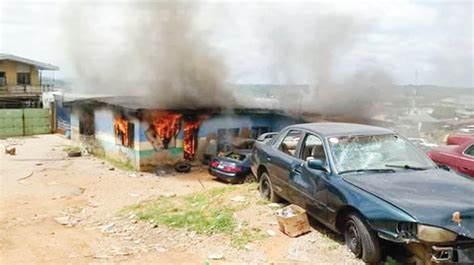
Fresh terrorist attacks across parts of northern Nigeria have plunged several rural communities into fear and uncertainty after armed men reportedly razed police stations, disrupted communication routes, and left residents effectively stranded without immediate protection.
The latest wave of violence has once again highlighted the fragile state of security in remote areas where local police outposts often serve as the only visible symbol of government authority. When those facilities are attacked and destroyed, entire communities are left exposed, isolated, and vulnerable to further assault.
According to local accounts, the attackers arrived late at night in coordinated groups, heavily armed and moving with alarming precision. Witnesses described hearing gunfire erupt across quiet settlements before flames lit up the night sky as police facilities and nearby structures were set ablaze.
Residents said panic spread quickly as families abandoned their homes and fled into nearby bushes, forests, and neighboring villages in search of safety. Many escaped with little more than the clothes they were wearing, leaving behind food supplies, valuables, and livestock.
In some communities, roads leading in and out were reportedly blocked or rendered unsafe, making escape difficult and delaying rescue efforts. Residents trapped overnight described terrifying hours spent hiding while listening for signs that the attackers had moved on.
The destruction of police stations has dealt a severe psychological and operational blow to already vulnerable areas. Rural police posts are often under-equipped and understaffed, yet they remain essential as first responders during emergencies.
Once disabled, communication between local residents and larger security commands becomes slower and less reliable, giving attackers greater freedom to strike and disappear before reinforcements arrive.
Community elders say these repeated attacks are becoming a dangerous pattern designed not only to inflict physical damage but also to undermine public confidence in the state’s ability to provide security.
Several local leaders expressed frustration that despite repeated warnings and previous incidents, stronger preventive measures had not been put in place. Some residents claimed unusual movements had been noticed in surrounding forests days before the attacks, but no additional deployment followed.
For farming communities, the consequences extend beyond immediate fear
Many residents now say they are too afraid to return to their fields. This comes at a critical agricultural period when delayed planting or abandoned harvests could deepen food shortages and worsen economic hardship.
Markets have shut down in affected areas, schools have suspended activities, and transport operators are refusing to travel routes considered unsafe. Entire local economies are grinding to a halt as insecurity expands.
Women and children are among the worst affected. Displaced families sheltering in neighboring communities face overcrowding, food scarcity, and uncertain access to healthcare. Aid remains limited, particularly in hard-to-reach villages.
Security experts note that terrorist and armed criminal groups increasingly favor attacks on isolated rural settlements because they know response times are often slow due to poor roads, weak telecommunications infrastructure, and stretched security resources.
They also exploit difficult terrain, including forests and ungoverned spaces, to evade capture after attacks.
Analysts argue that reactive deployments after attacks are no longer enough. Instead, they call for sustained intelligence-led operations, stronger local surveillance systems, and deeper cooperation between formal security agencies and community defense structures.
The attacks have renewed calls for a more permanent security presence in vulnerable northern corridors.
Residents argue that temporary reinforcements often withdraw too quickly, leaving communities exposed once media attention fades.
Government officials have condemned the violence and promised swift action to restore order. Security agencies say investigations are ongoing and efforts are underway to identify and apprehend those responsible.
Military patrols have reportedly been increased in some surrounding districts, though residents say confidence will only return when visible protection becomes consistent rather than occasional.
Political observers warn that persistent rural insecurity could have broader national consequences if left unchecked. Beyond humanitarian suffering, prolonged instability threatens food production, internal trade, education access, and public trust in institutions.
Many affected residents say they feel forgotten.
Some displaced villagers described the painful reality of watching years of hard work disappear in a single night. Burned homes, looted shops, and shattered public buildings stand as stark reminders of lives disrupted by violence.
Traditional rulers across the region have appealed for urgent intervention, insisting that communities cannot continue living under the constant shadow of attack.
Religious leaders have also urged unity, resilience, and stronger action from authorities, warning that fear must not be allowed to define the future of northern rural life.
For now, thousands remain displaced or trapped in uncertainty, waiting for reassurance that safety will return.
As smoke clears from the ruins of police stations once meant to symbolize protection, one message echoes across affected communities: Nigerians in rural regions deserve more than promises. They deserve visible, lasting security that allows them to live, work, farm, and raise families without fear.
Until that happens, each fresh attack deepens the sense of abandonment and raises urgent questions about how long vulnerable communities can continue to survive under the growing threat of terror.

