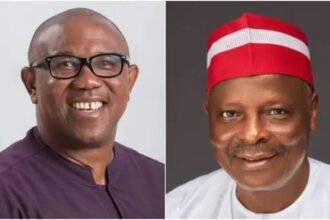

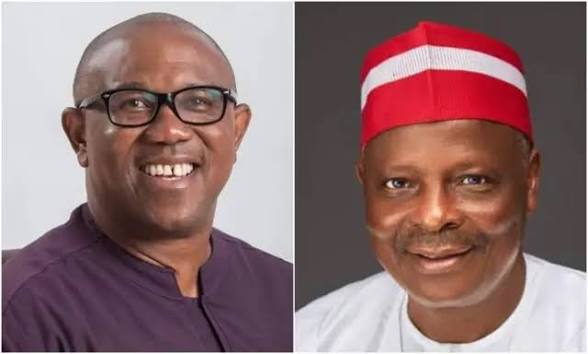
The reported move by Peter Obi and Rabiu Kwankwaso to align under the Nigeria Democratic Congress is said to have taken place on May 3 2026 and it arrives at a moment when Nigeria is not just preparing for another election but quietly searching for direction clarity and perhaps a different kind of political story.
The timing is sharp the symbolism even sharper and the implications are layered in ways that go beyond the surface excitement of a new alliance. It is easy to see this as a simple case of two influential figures joining forces but that reading would miss the deeper tension embedded in the move a tension between hope and skepticism between strategy and sincerity between the promise of unity and the reality of Nigeria’s complex political behavior.
For many Nigerians this moment feels like a reset button has been pressed not because the system has changed but because the arrangement of its most visible actors has shifted. Peter Obi built a reputation in recent years as a figure who could galvanize a new kind of voter energy particularly among younger Nigerians and urban professionals who felt disconnected from traditional political structures.
Rabiu Kwankwaso on the other hand carries a different kind of weight one rooted in long standing political networks disciplined grassroots mobilization and a loyal base that does not easily dissolve or migrate.
Bringing these two forces into one political home under the Nigeria Democratic Congress creates the appearance of balance a bridge between demographics regions and political cultures that rarely meet on equal footing.
Yet appearance and reality are rarely the same in Nigerian politics and that is where the real story begins to unfold. The idea of a united opposition has always carried a certain emotional appeal. It speaks to the frustration many feel about fragmented efforts that ultimately cancel each other out at the ballot box. In theory when strong contenders come together the arithmetic becomes simpler votes combine influence grows and the possibility of genuine competition increases. This move seems to follow that logic offering a pathway to reduce division and concentrate political energy in a way that could challenge established dominance.
But unity is not built on arithmetic alone. It is built on trust coherence and a shared sense of purpose that must extend beyond election day. One of the immediate questions that arises is whether the supporters of these two figures will see this alliance as a natural evolution or as a forced arrangement. Political loyalty in Nigeria is often personal as much as it is ideological and when personalities merge the lines of loyalty can blur rather than strengthen. A voter who believed deeply in one leader’s vision may struggle to reconcile that belief with the history or approach of the other. What looks like unity at the top can translate into quiet resistance at the base and that kind of resistance does not always announce itself loudly it shows up in low turnout in half hearted campaigning and in subtle shifts that only become visible when votes are counted.
There is also the matter of political identity. Over time both Peter Obi and Rabiu Kwankwaso have cultivated distinct narratives about who they are and what they represent. When those narratives converge under a new banner the question becomes whether they will blend into something coherent or clash in ways that weaken the message. Voters are not just choosing candidates they are choosing stories explanations for the past and promises about the future. If the new platform cannot tell a clear and convincing story that integrates both leaders without contradiction it risks sounding like a compromise rather than a vision.
Still it would be a mistake to dismiss the potential strength of this move. There is a strategic intelligence in recognizing that elections are not only about ideals but about structure reach and coordination. By joining the Nigeria Democratic Congress both figures may be attempting to build a platform that is less about individual ambition and more about collective viability. If that intention is genuine and if it is matched by disciplined organization the alliance could shift the tone of the 2027 race from one of predictable patterns to one of genuine contest.
The timing however introduces its own complications. Building a functional political machine is not something that happens overnight. It requires aligning state level structures resolving internal hierarchies managing expectations and ensuring that local actors feel included rather than displaced. With the election approaching the window for this kind of deep integration is narrow. Every unresolved disagreement every delayed decision and every perceived imbalance could become a fracture point that opponents are quick to exploit. In that sense the alliance is not just a bold step forward it is also a race against time.
Another layer of complexity lies in how this move will be interpreted by the broader political environment. Alliances can trigger reactions that reshape the field in unexpected ways.
Other parties may respond by strengthening their own coalitions redefining their strategies or intensifying their outreach. What begins as a unifying move for one group can lead to a chain reaction that ultimately increases competition across the board. This could be healthy for democracy encouraging more engagement more debate and more accountability but it could also lead to heightened tensions particularly if campaigns become more aggressive in their attempts to define and defend their positions.
There is also a deeper question about what this alliance represents in terms of political culture. Nigeria has seen alliances before some successful some short lived and others that dissolved under the weight of internal contradictions. Each new attempt carries the burden of that history. Voters remember promises that did not materialize and partnerships that fell apart when power was within reach. For this move to be seen as different it will need to demonstrate not just strategic alignment but a level of consistency and transparency that has often been missing in the past. Without that it risks being viewed as another episode in a familiar cycle where alliances are formed for elections and forgotten afterward.
At the same time there is a sense that something is shifting beneath the surface of Nigerian politics. The electorate is becoming more aware more vocal and in some cases more demanding. The rise of digital engagement has changed how political narratives are formed and challenged.
In this environment alliances are not judged only by their outcomes but by their process how they are formed how decisions are made and how inclusive they appear. The partnership between Peter Obi and Rabiu Kwankwaso will be scrutinized not just for what it achieves but for how it conducts itself along the way.
It is also worth considering the emotional dimension of this moment. Politics is often analyzed in terms of numbers strategies and outcomes but it is also driven by feelings hope frustration loyalty and fear. For some Nigerians this alliance may represent a renewed sense of possibility a belief that different factions can come together for a common goal. For others it may reinforce a sense of caution a reminder that political moves are often driven by calculations that do not always align with public expectations. These emotional responses matter because they influence how people engage whether they participate actively or withdraw quietly.
As 2027 approaches the success or failure of this alliance will depend on factors that go beyond the initial announcement. It will depend on whether the leaders involved can translate symbolic unity into practical coordination whether they can manage differences without allowing them to become divisions and whether they can present a vision that resonates across Nigeria’s diverse population. It will also depend on how voters choose to interpret the move whether they see it as a genuine attempt to reshape the political landscape or as a strategic maneuver within an unchanged system.
In the end what makes this moment significant is not just the alliance itself but what it reveals about the state of Nigerian politics. It highlights the ongoing search for effective opposition the challenges of building unity in a diverse society and the delicate balance between ambition and collaboration. The decision by Peter Obi and Rabiu Kwankwaso to come together under the Nigeria Democratic Congress is both a reflection of these dynamics and a test of whether they can be navigated successfully.
Whether this move will ultimately reshape the outcome of the 2027 election or become another chapter in Nigeria’s long history of political experimentation remains uncertain.
What is clear is that it has already changed the conversation forcing both supporters and critics to reconsider their assumptions about what is possible and what is likely. In that sense the alliance is not just about two politicians or one party it is about the evolving story of a nation still defining how power is contested shared and understood.