





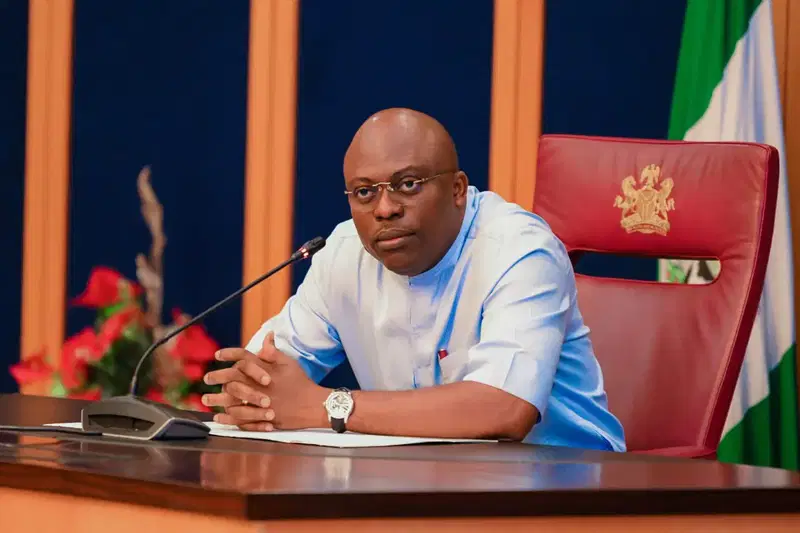
As political conversations begin to drift toward 2027, the situation in Rivers State is gradually taking a new shape, and at the center of it is Siminalayi Fubara.
What makes the moment particularly interesting is not just the speculation about a second-term ambition, but the way support for the governor appears to be forming subtly, steadily, and in ways that suggest a deeper shift within the state’s political structure.
Since assuming office, Fubara has operated under the shadow of a very public and complex political disagreement with his predecessor and former ally, Nyesom Wike. The fallout between the two has shaped much of Rivers’ political narrative, creating factions, testing loyalties, and raising questions about who truly controls the political machinery of the state. Yet, rather than being politically weakened by the situation, Fubara seems to be adapting to it in a way that is quietly strengthening his position.
What stands out is the nature of the support he is beginning to attract.
Unlike traditional political endorsements that often come with loud declarations and visible alignments, much of the backing around Fubara appears to be emerging through calculated alliances, grassroots engagement, and a growing perception that he represents continuity with a different tone. This kind of support may not always dominate headlines, but it tends to carry weight where it matters most within voting communities and local political networks.
There is also a strategic element to how Fubara is navigating his position. Rather than engaging in constant direct confrontation, his approach has often leaned toward maintaining administrative focus while allowing political structures to evolve around him. This has created space for stakeholders who may have initially been uncertain to gradually align, especially those who are more interested in stability than prolonged political conflict.
At the same time, the broader political environment in Rivers State is contributing to this shift. Political actors are already beginning to assess the landscape ahead of the next election cycle, weighing their options and identifying where long-term viability lies. In such moments, loyalty can be fluid, and influence is often determined not just by past dominance but by present relevance. Fubara’s growing visibility as a central figure in governance naturally positions him as a focal point for these calculations.
The ongoing tension with Wike, however, remains a defining factor. Wike’s influence both within Rivers State and at the national level cannot be dismissed. He retains strong political networks, significant experience, and a track record that still commands attention. This means that any consolidation of support around Fubara is happening within a contested space, where competing interests continue to shape outcomes.
What this creates is a layered political dynamic. On one hand, there is the legacy structure associated with Wike, built over years of political dominance. On the other hand, there is an emerging structure around Fubara, which appears to be less about immediate control and more about gradual alignment. The interaction between these two forces is likely to define the trajectory of Rivers politics in the coming years.
Another factor influencing the situation is public perception. For many residents, the priority is not necessarily political rivalry but governance—how policies affect daily life, infrastructure, and economic opportunities. In this sense, Fubara’s ability to maintain a sense of continuity in governance while projecting independence in leadership could become a key advantage. If the public begins to associate his administration with stability and progress, that perception could translate into stronger electoral backing over time.
The idea of a second-term ambition, therefore, is less about a formal declaration at this stage and more about political readiness. Signals are emerging not only from within his immediate circle but also from stakeholders who see value in continuity. These signals often precede official announcements, serving as a way to test the political atmosphere and build momentum gradually.
Looking ahead, the road to 2027 in Rivers State is unlikely to be straightforward. The interplay between established influence and emerging authority will continue to evolve, with alliances forming and shifting as the political calendar moves forward. What is clear, however, is that Fubara is no longer seen as a passive figure in that equation. Instead, he is increasingly becoming a central player whose decisions and positioning will carry significant weight.
In many ways, the current moment reflects a broader theme in Nigerian politics, where leadership transitions do not always follow predictable patterns. Power is negotiated, redefined, and sometimes quietly redistributed over time. Rivers State is now a clear example of this process in motion.
As discussions about 2027 continue to build, the focus will not only be on who declares intent but also on who successfully builds a coalition that can endure the pressures of political competition. For Fubara, the early signs suggest that such a coalition may already be taking shapeless visible perhaps, but potentially more resilient.

