





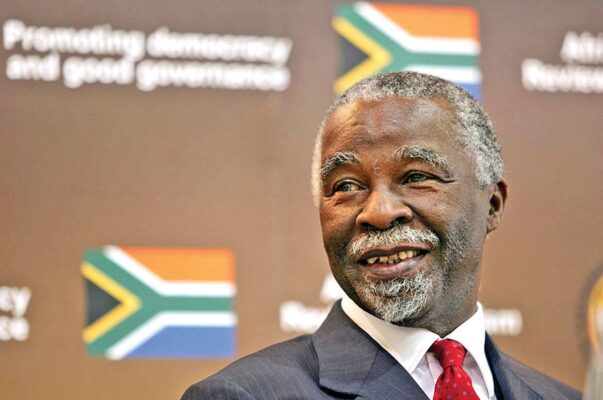
Former South African president Thabo Mbeki has asserted that African migration into South Africa is deeply tied to the anti-apartheid struggle and should not be blamed for the country’s worsening economic decline, unemployment, and social problems.
This is even as the mayor of Durban, Cyril Xaba, has ordered the transfer of Nigerians and other African nationals to a screening centre for verification of their legal status in South Africa.
The operation, carried out on Thursday, involved buses conveying foreign nationals from the Diakonia Centre in Durban’s central business district to a designated refugee reception facility where immigration documents were formally processed.
Videos circulating online showed African migrants being escorted into buses by South African law enforcement officials, triggering widespread reactions on social media.
Speaking at the AUDA-NEPAD @25 High Level Business Breakfast held in Cape Town on Thursday, Mbeki condemned rising anti-migrant sentiment despite Africa’s shared history, maintaining that South Africa’s economic struggles and unemployment crisis cannot be linked to undocumented Africans.
“When you tell an African migrant living in Johannesburg to go home, he doesn’t understand,” he said, stressing that many South Africans fail to understand that the continent collectively supported South Africa’s liberation struggle during apartheid. “The struggle was not just for South Africans, it was their struggle,” he said.
He argued that African countries came to regard the anti-apartheid struggle as an African struggle, not merely a South African one. According to him, this historical connection explains why many Africans continue to move to South Africa and feel a sense of belonging to the country.
While insisting that foreign nationals are being wrongly blamed for problems caused by poor governance and economic mismanagement, the former president stated that the country’s decline began after years of economic growth between 1994 and 2008.
“We know the history in detail of how South Africa, from 1994 to 2008, 2009, reached a growth rate of six per cent. From 2009, it goes in the opposite direction. It wasn’t caused by undocumented immigrants… The people who caused the decline are laughing in the corner because you are pointing not at them but someone else,” said the former president.
According to him, South Africa experienced economic growth and lower crime rates during earlier democratic years despite the presence of undocumented immigrants, arguing that the country’s decline started due to leadership and structural failures, not migration. He warned that unemployment and other economic challenges would not be solved through hostility towards foreign nationals.
“One prediction I will make is Africans will continue to come to South Africa. It doesn’t matter what you do. You can’t change the mind of these Africans,” Mbeki said.
Only recently, Economic Freedom Fighters leader Julius Malema had condemned locals’ attacks and hostility toward foreign nationals in South Africa.
In an interview with Sky News shared on X on Thursday, Malema dismissed claims that xenophobia was driving tensions, instead describing the violence and intimidation as “gangsterism sponsored by the government”.
“There’s no xenophobia in South Africa. It’s just a group of charlatans, extortionists, disruptors and corrupt individuals who want to extort foreign nationals,” Malema said.
He argued that South Africans themselves were responsible for most violent crimes in the country, citing rape, assault, and prison statistics to challenge narratives blaming migrants for criminality.

