
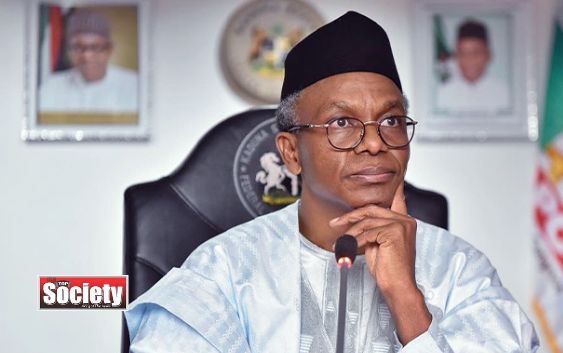
Former Kaduna State governor Nasir El-Rufai has explained why he did not physically participate in the recent “Occupy the National Assembly” protest led by Peter Obi and other activists demanding the restoration of real-time electronic transmission of election results in Nigeria’s Electoral Act.
The protest, which drew hundreds of demonstrators to the gates of the National Assembly in Abuja, focused on lawmakers’ decision to remove the explicit phrase “real-time” from provisions relating to electronic transmission of results in the proposed amendment to the Electoral Act. Protesters argue that the deletion weakens transparency safeguards ahead of the 2027 general elections and could undermine public confidence in the democratic process.
Peter Obi, who was present at the protest, described the removal of the real-time clause as a setback for electoral credibility. Civil society groups and youth movements also lent their voices to the demonstration, framing the issue as a non-partisan demand for stronger democratic protections.
However, El-Rufai was notably absent from the protest, despite later expressing sympathy for the core demand. In a public statement, the former governor clarified that his absence should not be interpreted as opposition to the principle of real-time electronic transmission of election results. According to him, circumstances beyond his control prevented him from being physically present at the National Assembly during the demonstration.
El-Rufai explained that he was not in Abuja at the time of the protest. He stated that had he been in the country, he would have considered joining the demonstration, as he supports reforms aimed at strengthening the integrity of Nigeria’s electoral process. His remarks suggest that his absence was logistical rather than ideological.
The former governor emphasized that credible elections are essential for Nigeria’s stability and progress. He acknowledged that technological solutions, including electronic transmission of results, can help reduce manipulation, speed up collation, and minimize post-election disputes. In his view, improving electoral transparency is not a partisan matter but a national one that should concern all stakeholders.
At the heart of the controversy is the interpretation of what the amended Electoral Act should mandate.
Advocates for real-time transmission argue that explicitly requiring immediate electronic upload of results from polling units would reduce opportunities for tampering and enhance public trust. They believe that ambiguity in the law could allow discretion that may weaken accountability.
On the other hand, some lawmakers have maintained that while electronic transmission remains part of the electoral framework, specifying “real-time” in rigid terms could create operational challenges in areas with poor network connectivity. They argue that the electoral commission should retain flexibility to determine the most practical approach in varying conditions across the country.
El-Rufai’s comments place him in an interesting position within the broader political landscape. Although he did not stand side-by-side with Peter Obi at the protest, his support for the principle of transparent elections signals alignment on at least one major reform issue. This development has sparked conversations among political observers about possible cross-party consensus on electoral reforms ahead of 2027.
It was gathered by Top Society that the Occupy NASS protest itself remained largely peaceful, with security personnel stationed around the National Assembly complex. Demonstrators carried placards calling for electoral accountability and chanted slogans demanding that lawmakers restore the deleted clause.
The protest reflects growing civic engagement among Nigerians, particularly young voters who have become increasingly vocal about governance and democratic standards.
El-Rufai also used the opportunity to reiterate that electoral credibility is foundational to national unity.
According to him, when citizens trust the voting process, political tensions are reduced and governance becomes more stable. Conversely, doubts about election integrity can fuel division and prolonged legal battles.
While some critics questioned why El-Rufai did not publicly mobilize supporters to join the demonstration virtually or issue a stronger statement earlier, others viewed his clarification as evidence that electoral reform transcends political rivalry. His position suggests that discussions about the Electoral Act may continue to attract attention from figures across Nigeria’s political spectrum.
As debate continues within the National Assembly, the question remains whether lawmakers will revisit the wording of the amendment bill. Public pressure from activists, opposition figures, and civil society organizations may influence further deliberations. The outcome will likely shape preparations for the 2027 elections and determine how electronic transmission is implemented in practice.
For now, El-Rufai’s explanation underscores a broader reality: Nigeria’s conversation about democracy is evolving. Even when political actors differ on strategy or presence, the underlying demand for transparent and credible elections appears to be gaining momentum. Whether through street protests, legislative debate, or public commentary, the issue of real-time result transmission has become a defining topic in the nation’s democratic discourse.
As Nigerians watch developments unfold, the central focus remains clear ensuring that future elections are conducted in a manner that strengthens trust, accountability, and national cohesion.