
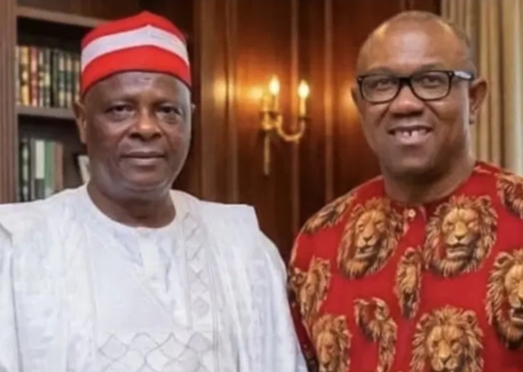
Former Kano State Governor and vice-presidential candidate of the Nigeria Democratic Congress (NDC), Rabiu Musa Kwankwaso, has disclosed that the party’s presidential candidate, Peter Obi, signed a written agreement committing himself to serving only one four-year term if elected president in the 2027 general election.
Kwankwaso made the revelation during an interview on Channels Television, where he spoke extensively about the political arrangement between him and Obi ahead of the 2027 presidential race.
According to him, the agreement was reached after discussions on the need to maintain political balance and national unity. He explained that both leaders agreed that the presidency should remain in the South for one term before returning to the North in 2031.
The former Kano governor said he has full confidence that Obi will honour the agreement and has no reason to believe otherwise.
“I personally believe him. Based on what I know about him now, I do not think he will change his position when the time comes. We are gentlemen, and we have even put the agreement in writing,” Kwankwaso said.
He further revealed that two separate documents were signed to formalise the arrangement. According to him, one agreement was signed directly between both politicians, while another was signed with the party to ensure that the understanding remains binding and transparent.
Kwankwaso stressed that the agreement clearly states that if Obi wins the presidency in 2027, he will serve only one term from 2027 to 2031, after which power will return to the North.
He explained that the arrangement was designed to strengthen trust among political stakeholders and reassure supporters across different regions of the country that power-sharing would be respected.
“The understanding is simple. We will work together as a team, as a political party and as partners. After the four-year tenure, power will return to the North. That is the agreement we reached,” he said.
Speaking on why he agreed to become Obi’s running mate despite his own presidential ambitions, Kwankwaso said both men carefully examined the country’s political realities before reaching their decision.
According to him, they concluded that allowing the South to complete a four-year presidency before power returns to the North would help promote fairness, stability and national cohesion.
He noted that the arrangement reflects the desire of many Nigerians who believe that political power should rotate between the country’s major regions in order to strengthen unity and reduce political tension.
“We felt that the presidency should remain in the South for four years and then return to the North. We believe this is a fair arrangement and one that can help move the country forward as one united family,” he added.
Kwankwaso also dismissed suggestions that the agreement was merely a campaign promise. He insisted that the understanding was documented and supported by both leaders as part of their broader vision for the country.
When asked whether he intends to contest for the presidency in 2031, Kwankwaso declined to make a direct declaration. Instead, he said the party’s immediate focus is on winning the 2027 election and delivering good governance to Nigerians.
He explained that while the party has long-term plans, its current priority is building support across the country and presenting a credible alternative to voters.
“We are concentrating on our short-term objective, which is the 2027 election. At the same time, we have medium-term and long-term plans for the country, and we are working towards achieving them,” he said.
Peter Obi has on several occasions publicly stated that he would serve only one term if elected president. The former Anambra State governor has argued that four years would be enough for him to lay the foundation for economic reforms, improve governance and stabilise the country.
According to Obi, he has no intention of remaining in office beyond a single term, insisting that his focus is on service rather than political longevity.
His position, however, has continued to generate debate within the political space. While supporters see the promise as a demonstration of commitment and sincerity, critics have questioned whether such a pledge can be guaranteed once a candidate assumes office.
Despite the criticism, Kwankwaso maintained that he trusts Obi’s word and believes the written agreement signed by both men will be respected if they emerge victorious in the 2027 presidential election.