






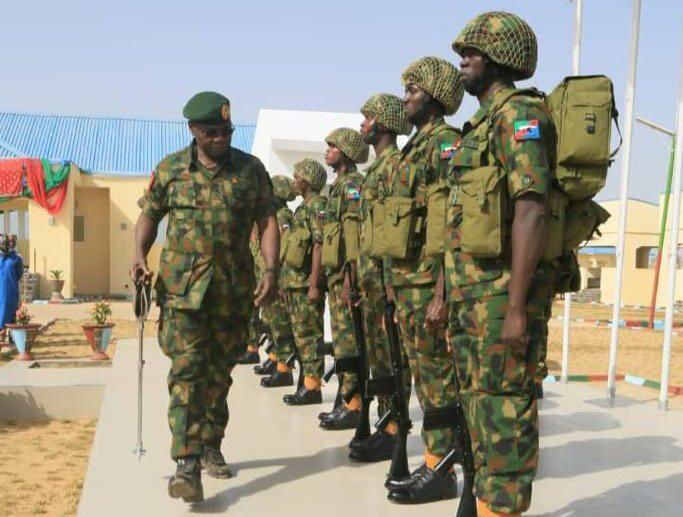
President Bola Tinubu has approved a major expansion of the Nigerian Army, authorising an increase in its operational structure from eight to 12 divisions and directing the recruitment of 28,000 additional personnel.
The move marks one of the most significant military reforms in recent years and reflects the Federal Government’s determination to strengthen national security amid persistent threats from insurgency, banditry, kidnapping, communal clashes, and other forms of violent crime.
The approval was announced following a high-level security review involving military authorities and senior government officials. According to the Presidency, the expansion is designed to improve the Army’s operational capacity, enhance rapid response to security emergencies, and ensure that troops are better positioned to protect lives and property across the country.
Nigeria has continued to grapple with multiple security challenges affecting different regions. While the North-East has faced insurgency for more than a decade, the North-West has witnessed growing cases of banditry and mass kidnappings. Parts of the North-Central have experienced violent clashes between farming and herding communities, while the South-East has battled attacks linked to criminal groups and separatist activities. Oil theft and piracy have also remained concerns in the Niger Delta.
Against this backdrop, the Federal Government believes that expanding the Nigerian Army will improve troop deployment, reduce operational pressure on existing formations, and provide commanders with greater flexibility in responding to emerging threats.
Under the new arrangement, the Nigerian Army will increase from eight to 12 divisions. The implementation will take place in phases to ensure a smooth transition and effective deployment of resources.
The first phase of the exercise will involve the establishment of the 5th, 9th, and 10th Divisions, alongside the reorganisation of existing formations. This phase is expected to be completed by September 2026. The second phase will include the establishment of the 83 Division in Benin City and additional restructuring to conclude the expansion by December 2026.
The new divisions will be strategically located in Makurdi, Ilorin, Jalingo, and Benin City. These locations were selected based on operational requirements and the need to strengthen military presence in key parts of the country.
In addition to creating new divisions, President Tinubu approved the recruitment of 28,000 new personnel into the Nigerian Army. The recruitment drive is expected to strengthen the military’s manpower, replace retiring officers and soldiers, and improve the Army’s ability to sustain operations across multiple theatres simultaneously.
The planned recruitment is also expected to create employment opportunities for thousands of young Nigerians who meet the required qualifications for military service. Successful recruits will undergo intensive training before being deployed to various formations nationwide.
Military analysts have welcomed the initiative, noting that expanding troop strength has become necessary as security threats continue to evolve. They argue that a larger and better-equipped Army will improve surveillance, intelligence gathering, border security, and rapid intervention capabilities.
Security experts, however, have stressed that increasing personnel alone may not completely solve Nigeria’s security challenges. They insist that sustained investment in modern weapons, intelligence technology, surveillance equipment, logistics, and troop welfare will be essential to achieving the desired results.
Analysts also emphasise the importance of collaboration among the Nigerian Army, Air Force, Navy, Police, Department of State Services, Nigeria Security and Civil Defence Corps, and local intelligence networks. They argue that coordinated operations and information sharing remain critical to dismantling criminal networks and preventing attacks.
Beyond military operations, experts believe lasting peace requires addressing the root causes of insecurity. They point to unemployment, poverty, poor education, illegal mining, weak border control, and youth radicalisation as factors that continue to fuel violence in many communities. They recommend that security reforms be accompanied by economic development, education, social inclusion, and improved governance.
The Tinubu administration has consistently identified security as one of its top priorities since assuming office. Over the past year, the government has approved the acquisition of additional military equipment, supported ongoing counter-terrorism operations, and increased efforts to secure critical infrastructure across the country.
The expansion of the Nigerian Army is expected to complement these initiatives by ensuring that military formations are closer to vulnerable communities and can respond more quickly to security incidents.
Residents in several parts of the country have expressed optimism that the new divisions will strengthen security and improve confidence among citizens. Communities that have suffered repeated attacks hope the increased military presence will deter criminal activities and restore normal economic and social life.
Business owners and investors are also likely to view the development positively. Security remains a major factor influencing investment decisions, and improved stability could encourage economic activities, particularly in agriculture, mining, manufacturing, and commerce.
Nevertheless, some observers have urged the government to ensure transparency throughout the recruitment process. They emphasised that merit, professionalism, and fairness should guide the selection of new recruits to build a highly disciplined and effective fighting force.
Others have called for improved welfare packages for serving personnel, including better accommodation, healthcare, insurance, salaries, and support for the families of fallen heroes. They argue that motivated troops are better positioned to carry out their constitutional responsibilities effectively.
As the implementation begins, attention will focus on how quickly the new divisions become operational and whether the recruitment targets are achieved within the proposed timeline. Success will also depend on adequate funding, effective planning, and continuous collaboration among security agencies.
President Tinubu’s approval of the Army’s expansion represents a significant milestone in Nigeria’s ongoing efforts to strengthen national security. While the initiative alone may not eliminate every security challenge facing the country, it demonstrates the government’s commitment to building a stronger military capable of responding to evolving threats.
If successfully implemented alongside broader economic and governance reforms, the expansion of the Nigerian Army could contribute significantly to restoring peace, protecting communities, boosting investor confidence, and creating a safer environment for national development.
For many Nigerians, the hope is that this ambitious reform will translate into lasting improvements in security and help pave the way for a more stable and prosperous future.

