


Former President Olusegun Obasanjo has nostalgically recalled that Nigeria once ranked 37th among the world’s economies, suggesting that if successive governments had sustained that trajectory, the country would by now be among the top ten formidable economies in the world.
This was as he attributed Nigeria’s long-standing dependence on rice imports to the decision of the civilian administration that took office in 1979 to reverse a ban imposed by his outgoing military regime.
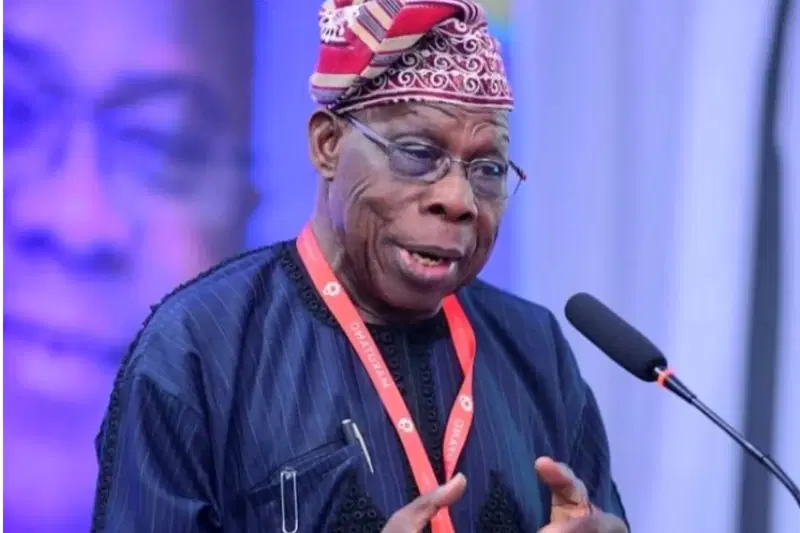
Obasanjo spoke in Abuja on Thursday at the International Memorial Lecture and Leadership Conference marking the 50th anniversary of the assassination of former Head of State, General Murtala Muhammed. The event centred on Muhammed’s historic “Africa Has Come of Age” speech delivered at the Organisation of African Unity Summit in Addis Ababa.
Reflecting on the transition from military to civilian rule in 1979, the ex-president said his administration had been close to making Nigeria self-sufficient in rice production before handing over the reins of government to President Shehu Shagari.
“By the time we left in July 1979, we wanted to be self-sufficient in rice production. We requested a report on what was in the fields, and the findings indicated that we would achieve self-sufficiency that year,” he said.
Based on that assessment, he explained, his government banned rice importation shortly before leaving office in October 1979.
According to him, the incoming civilian administration lifted the ban soon after assuming office, a move he said undermined the progress made toward local production of the commodity.
He recounted an incident involving a politically connected rice importer who allegedly inflated the cost of a contract to secure financial gain, describing it as illustrative of the challenges that followed the policy reversal.
“Since the lifting of the rice import ban in 1979, we have not fully recovered. That is why we are still importing rice today,” he said, adding that inconsistent policies have hindered Nigeria’s development.
Obasanjo argued that Nigeria’s broader economic struggles originated in part from an inability to sustain sound policies over time.
“What we need to do is reform and produce. Reform and produce,” he emphasised, urging African leaders to prioritise structural reforms and productive capacity.
Obasanjo said Africa must achieve sustained annual GDP growth of between nine and 10 per cent to realise its full potential, noting that such growth rates had been attained in the past.
Using agriculture as an example, he said cocoa production tripled during his civilian presidency, rising from 150,000 metric tonnes to 450,000 metric tonnes within a few years, before later declining to about 300,000 metric tonnes.
“We have gone backwards. That is not how Africa will come of age,” he said.
Beyond economic issues, Obasanjo reflected on leadership and governance, describing his former principal, General Murtala Muhammed as patriotic, disciplined and committed to national service.
He observed that one of Muhammed’s notable legacies was preparing a successor to continue his policies, adding that subsequent leaders, including himself, had struggled to build enduring succession frameworks.
Obasanjo’s military administration introduced measures such as “Operation Feed the Nation” and austerity policies aimed at promoting self-sufficiency, while the civilian government that followed adopted a more liberalised import regime amid mounting public demand for consumer goods.
The former President concluded that sustained reform, policy consistency and productive investment remain essential for Nigeria and Africa to achieve lasting development.