


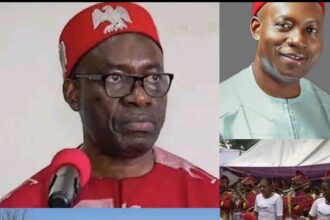



Former President Goodluck Jonathan has once again become the focus of national political discussion after failing to submit the Peoples Democratic Party’s presidential nomination form ahead of the early political positioning for the 2027 general election.
The development has generated widespread speculation across the country, with many now questioning whether the former president is seriously considering a return to active electoral politics or simply allowing his name to remain part of Nigeria’s broader political calculations.
For several months, discussions around Jonathan’s possible return to the presidential race have continued to dominate political circles. Across party lines, supporters and analysts have floated his name as a possible consensus candidate capable of reshaping the opposition landscape and offering a fresh challenge to the current administration. His reputation as a calm political figure and his historic concession of defeat in 2015 have continued to strengthen his image as a statesman whose political relevance remains intact more than a decade after leaving office.
The expectation in recent weeks was that Jonathan would make a decisive move by either purchasing and submitting nomination forms or publicly distancing himself from the growing calls for his return. Instead, the former president maintained his characteristic silence, allowing the deadline to pass without any official declaration.
His failure to submit the form has now intensified uncertainty over his next political move. For many observers, this silence reflects strategic caution rather than outright rejection of presidential ambition.
Jonathan has always approached political decisions carefully, often preferring quiet consultations to dramatic public announcements. Those familiar with his political style say he is unlikely to rush into any major contest without first assessing legal, institutional, and political realities.
One of the biggest concerns surrounding his possible candidacy remains the constitutional debate over his eligibility to contest another presidential election. Since Jonathan completed the tenure of his late predecessor before winning a full term of his own, legal experts have remained divided over whether he can seek another mandate under Nigeria’s constitutional two-term limit.
Although supporters insist he remains fully eligible, opponents argue that any attempt to run would face immediate legal challenges capable of distracting from the campaign itself. This unresolved question has likely contributed to his reluctance to formally enter the race at this stage.
Beyond legal uncertainty, the internal crisis within the Peoples Democratic Party remains another major obstacle.
The PDP continues to struggle with deep internal divisions, leadership disputes, and unresolved power struggles between competing factions. These tensions have weakened the party’s national cohesion and raised concerns about its readiness to present a united front in 2027.
For a figure like Jonathan, whose political strength depends heavily on consensus and broad institutional support, entering a divided political structure could prove risky.
Political analysts argue that Jonathan would only consider contesting if there is clear evidence of party unity and a strong national coalition willing to support his candidacy. Without such assurances, his involvement could expose him to avoidable political battles capable of damaging his carefully preserved legacy.
His silence may therefore be less about indecision and more about waiting for the political environment to stabilize.
There is also the question of whether Jonathan genuinely desires a return to frontline politics.
Since leaving office, he has built a respected international profile as a diplomat, election observer, and advocate for democratic stability across Africa. His post-presidency years have largely been defined by statesmanship rather than partisan confrontation.
Returning to Nigeria’s intensely competitive political arena would require abandoning much of that neutrality and exposing himself once again to the pressures of partisan warfare.
Many believe Jonathan may prefer to remain above daily political conflict unless convinced that his intervention is absolutely necessary for national stability.
Still, his continued relevance cannot be ignored.
Few Nigerian politicians command the level of cross-regional recognition and political goodwill that Jonathan enjoys. His support base cuts across traditional party boundaries, and his image remains relatively positive among many Nigerians who associate his administration with stability and restraint.
This enduring popularity explains why political actors continue to court him despite his public silence.
His potential candidacy would instantly transform the opposition landscape and force major political realignments across the country.
For rival aspirants already positioning themselves for 2027, Jonathan’s uncertainty creates a difficult political calculation. Many must now decide whether to proceed aggressively with their own ambitions or remain cautious in case the former president eventually declares interest.
This uncertainty could delay alliance-building efforts and complicate early campaign planning within opposition circles.
At the same time, it keeps Jonathan politically relevant without requiring him to make any immediate commitment.
That may be precisely the advantage of his current silence.
By refusing to confirm or deny his interest, Jonathan retains strategic flexibility while allowing political forces to reveal their intentions around him. He can continue to assess the national mood, monitor party developments, and evaluate legal outcomes before making any final decision.
For now, his failure to submit the PDP presidential nomination form does not necessarily close the door on a 2027 presidential bid.
Instead, it signals caution, patience, and careful observation from a politician who has always moved deliberately.
Whether that caution eventually leads to a formal declaration or a complete withdrawal from electoral politics remains uncertain.
What is clear, however, is that Goodluck Jonathan remains one of the most influential undeclared figures in Nigeria’s evolving 2027 political conversation. Until he speaks directly, speculation will continue to grow, and his silence will remain one of the most powerful political statements in the country today.

