



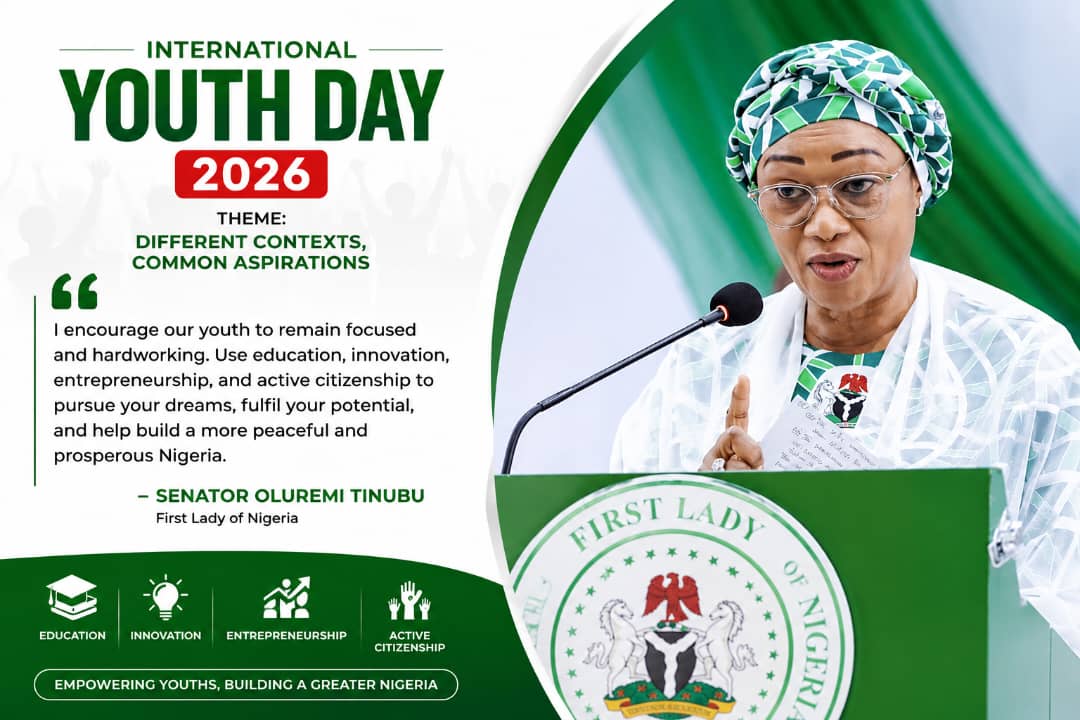
Nigeria’s First Lady, Senator Oluremi Tinubu, has continued to emphasise the importance of education, innovation, digital skills and entrepreneurship as key pathways for young Nigerians seeking to build sustainable livelihoods and contribute meaningfully to national development.
Her message comes at a time when Nigeria’s youthful population is facing a rapidly changing economic environment, with traditional employment opportunities increasingly competing with technology-driven careers, entrepreneurship and other forms of self-employment.
For the First Lady, education should not be viewed simply as a route to obtaining certificates, but as a foundation for developing the knowledge, creativity and problem-solving abilities required to succeed in a modern economy.
Her advocacy has been reflected in several initiatives and engagements over the past year, particularly through the Renewed Hope Initiative, where she has supported programmes focused on education, technology, women and youth empowerment.
In May 2026, Senator Tinubu inaugurated a N1 billion Information and Communication Technology Experience Centre at Ekiti State University. The facility, established through a partnership involving her Renewed Hope Initiative and the Tertiary Education Trust Fund, was presented as an investment in digital education, research, innovation and future-ready skills for young Nigerians.
The development is significant because the global economy is increasingly driven by technology and digital knowledge. Skills in areas such as artificial intelligence, software development, digital marketing, data analysis, cybersecurity and other technology-related fields are creating opportunities that were barely available to previous generations.
The First Lady’s position is that Nigerian youths must be prepared to take advantage of these opportunities rather than remain dependent solely on conventional white-collar employment.
This emphasis on innovation also aligns with broader Federal Government efforts to move Nigerian research and inventions from laboratories and universities into the marketplace. In March, the Minister of Innovation, Science and Technology, Kingsley Udeh, disclosed plans for the “Energise Commercialisation Now” initiative during a strategic engagement with the First Lady.
The programme is designed to connect researchers, universities, innovators, industries and investors so that ideas and discoveries can be transformed into commercially viable products, businesses and jobs. It is expected to focus particularly on young people, women, researchers and innovators.
For Nigerian youths, the message is therefore broader than simply “get a job.” It is a call to develop skills, identify problems within their communities and find innovative ways of creating solutions that can generate income and employment for others.
Entrepreneurship has become particularly important in an economy where many young graduates struggle to secure formal employment immediately after leaving school. Small businesses, technology startups, creative enterprises, agriculture, manufacturing and digital services have increasingly become alternative avenues through which young Nigerians can earn a living.
Education remains at the centre of that process.
Without adequate education and skills development, many young people risk being left behind as the nature of work changes. A young person with access to education, digital tools and practical training is better positioned to identify opportunities and adapt to changing economic conditions.
The First Lady has also placed considerable emphasis on ensuring that children and young people have access to educational resources from an early stage. In July, she donated 140,000 copies of seven books to the Federal Ministry of Education for distribution to public school libraries nationwide. The initiative was described by the ministry as an investment in literacy, values-based education and the holistic development of Nigerian children.
Her support for technology education has also extended to encouraging young girls to participate in science, technology, engineering and mathematics-related fields.
At a June 2026 reception for winners of the National Girls in ICT Competition, Senator Tinubu commended young Nigerian girls for their creativity and determination in using technology to address societal challenges. The competition engaged more than 3,700 girls across Nigeria’s six geopolitical zones.
Such initiatives reflect a growing recognition that Nigeria’s future economic strength will depend significantly on the ability of its young population to compete in a knowledge-based economy.
Nigeria has one of Africa’s largest and youngest populations. This demographic reality can become a major advantage if young Nigerians are adequately educated, skilled and economically empowered. But without sufficient opportunities, the same youthful population can face unemployment, poverty and social frustration.
This is why calls for entrepreneurship must go hand in hand with policies that make it possible for businesses to survive.
Young Nigerians need access to affordable financing, reliable electricity, good roads, affordable internet, markets, mentorship and an environment where businesses can operate without excessive regulatory burdens. Education and motivation can encourage entrepreneurship, but infrastructure and economic policies determine whether many businesses will survive beyond their first few years.
The challenge, therefore, is not simply convincing young Nigerians to become entrepreneurs. It is also creating an ecosystem in which their ideas can grow.
The First Lady’s advocacy for innovation is particularly relevant in this regard. Nigeria already has a large community of young technology developers, creatives, entrepreneurs and innovators producing solutions in areas ranging from financial technology and agriculture to healthcare, education and entertainment.
Many of these young Nigerians have demonstrated that they can compete internationally when given the right opportunities.
The Federal Government’s “Research to Revenue” agenda similarly seeks to strengthen the connection between Nigerian research institutions and the private sector, with the aim of turning research outcomes into businesses, industries, jobs and exports.
For students, graduates and young entrepreneurs, the implication is clear: academic knowledge should increasingly be combined with practical skills.
A degree can provide a strong foundation, but additional competencies can determine how effectively an individual navigates the modern labour market. Communication, technology, financial literacy, critical thinking, creativity and problem-solving are increasingly valuable across different professions.
Young Nigerians are also being encouraged to look beyond government employment as the only measure of career success.
While public-sector jobs remain important, the country’s economic transformation requires millions of productive enterprises capable of employing people and creating value. A young entrepreneur who builds a successful business is not only creating personal income but potentially providing opportunities for other Nigerians.
At the same time, entrepreneurship should not be presented as an easy escape from economic hardship. Starting and sustaining a business requires planning, discipline, access to capital and the ability to understand customers and markets.
The First Lady’s emphasis on education, innovation and entrepreneurship therefore comes at an important moment for Nigeria. The country’s ability to convert its large youthful population into an economic advantage will depend on how effectively young people are equipped to participate in the emerging economy.
Ultimately, the future of Nigeria’s youth will require more than motivational speeches. It will require sustained investment in schools, universities, vocational training, digital infrastructure, research, innovation hubs, financing and policies that allow businesses to grow.
For young Nigerians, however, the message remains one of opportunity: education can provide knowledge, innovation can turn knowledge into solutions, and entrepreneurship can turn solutions into sustainable businesses.
As Nigeria seeks to build a more productive and technology-driven economy, empowering its young population could prove to be one of the country’s most important investments. The challenge now is ensuring that the opportunities being discussed reach young Nigerians not only in major cities, but also in communities across the country.