




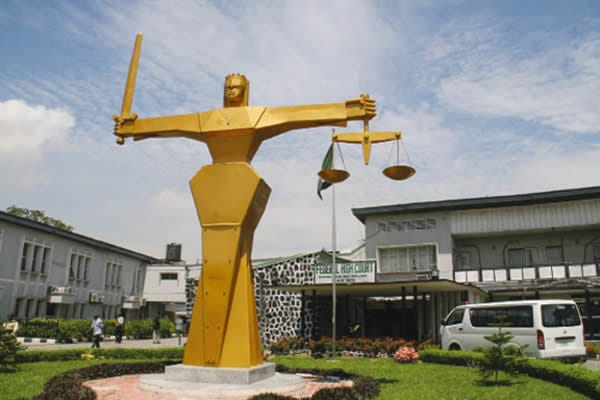
The Federal High Court in Abuja has entered a critical phase in the high-profile case involving six individuals accused of plotting to overthrow the administration of President Bola Ahmed Tinubu, as proceedings shifted into what legal experts describe as a “trial-within-trial” to determine the admissibility of key confessional statements.
The legal process, which has attracted intense national attention, marks a significant moment in what has become one of Nigeria’s most closely watched cases involving allegations of treason and threats to national stability. At the heart of the fresh proceedings is the question of whether statements allegedly made by the defendants during military interrogation were voluntarily given or extracted under duress.
Presiding over the matter, Justice Joyce Abdulmalik directed both prosecution and defence teams to focus strictly on the issue before the court: whether the confessional statements were legally obtained and can be admitted as evidence in the main trial.
The prosecution, led by the Director of Public Prosecutions of the Federation, argued that all investigative procedures followed due process and complied fully with Nigerian law.
According to government lawyers, the defendants were informed of their constitutional rights, granted legal protections, and were not subjected to intimidation or unlawful treatment while making their statements.
To support this claim, the prosecution presented an officer of the Nigerian Army Corps of Military Police as its first witness. The officer told the court that the accused persons remained calm throughout questioning and voluntarily signed written statements after interviews were conducted.
He further testified that all procedures were carried out in accordance with the Administration of Criminal Justice Act and relevant constitutional safeguards, adding that video recordings and digital documentation of the interrogations were preserved to ensure transparency.
The prosecution also tendered several exhibits before the court, including written statements allegedly signed by the accused, electronic storage devices, and video footage said to capture portions of the interrogation process.
However, the defence mounted a strong challenge against the admissibility of the evidence, insisting that some of the statements were obtained through coercive means and should not be relied upon in determining guilt or innocence.
Lawyers representing the defendants argued that their clients were subjected to undue pressure and psychological intimidation during military custody, making any statements obtained unreliable under Nigerian law and international human rights standards.
The defence cited provisions of the Anti-Torture Act and constitutional protections against self-incrimination, maintaining that no confession extracted under questionable circumstances should be admitted in court.
The six defendants, who include retired military personnel and at least one serving security officer, have pleaded not guilty to charges ranging from conspiracy to commit treason to acts capable of destabilising national security.
Their arrest and prosecution sparked widespread public debate, with many Nigerians divided over the seriousness of the allegations and the broader implications for democratic governance and civil liberties.
Political analysts have noted that coup-related allegations remain highly sensitive in Nigeria due to the country’s history of military intervention in politics. Though Nigeria has sustained democratic rule since 1999, memories of past coups still shape public discourse whenever such accusations emerge.
Observers say the current proceedings carry symbolic weight beyond the courtroom, as they test both the government’s resolve to protect democratic institutions and the judiciary’s independence in handling politically charged cases.
Legal experts have explained that a trial-within-trial is not uncommon in criminal proceedings where the voluntariness of a confession is disputed. The process allows the court to separately assess how evidence was obtained before deciding whether it can be considered during the main case.
If the court finds that the statements were obtained unlawfully, they may be excluded entirely from the substantive trial, potentially weakening the prosecution’s case. If admitted, however, the statements could become central to proving the allegations against the accused.
Outside the courtroom, reactions have continued to pour in from civil society organisations, legal commentators, and political observers.
Some rights groups have called for strict scrutiny of the prosecution’s methods, warning that allegations of torture or coercion must never be dismissed lightly, regardless of the severity of the charges.
Others argue that the state has a duty to act decisively against any genuine threat to constitutional order and that all credible evidence should be examined carefully.
For many Nigerians, the unfolding legal drama raises deeper questions about national security, accountability, and trust in democratic institutions.
As proceedings continue, the court is expected to hear additional testimony from investigators, defence witnesses, and technical experts who may shed more light on the disputed confessions.
The matter has been adjourned for further hearing, with anticipation building over what the court’s eventual ruling on the contested evidence could mean for the broader case.
Whatever the outcome, the proceedings are already shaping up as a defining legal test for Nigeria’s justice system and its ability to balance national security concerns with the fundamental rights guaranteed under the constitution.

