



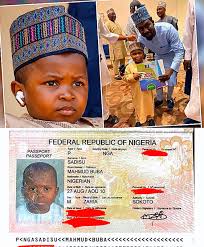
The controversy surrounding the withdrawal of a young House of Representatives aspirant has continued to generate debate across Nigeria, with growing public attention focused not only on his political ambition but also on conflicting claims regarding his actual age.
The aspirant, who had earlier attracted national attention after presenting himself as a 30-year-old seeking elective office, became the subject of intense scrutiny following allegations that he may, in fact, be far younger than claimed. While he maintained that he was 30 years old and attributed his youthful appearance to dwarfism, several reports and social media discussions later raised questions about the accuracy of that claim.
The issue gained momentum after documents circulated online allegedly suggesting that the aspiring lawmaker could be as young as 16 years old. Although the authenticity of the documents has remained a matter of debate and no official confirmation has conclusively settled the matter, the allegations quickly became one of the most discussed political stories in the country.
Shortly afterward, the aspirant announced his withdrawal from the race.
In his public statement, he did not cite age-related concerns as the reason for stepping down. Instead, he pointed to personal considerations and broader political calculations. However, the timing of the decision has continued to fuel speculation among observers who believe the age controversy may have played a significant role behind the scenes.
Political analysts note that regardless of the reasons officially given, the allegations had already shifted attention away from the issues he hoped to campaign on and toward questions about his eligibility and personal background. What began as an inspiring story of a young person seeking public office soon became dominated by debates over identity, documentation, and credibility.
For many Nigerians, the episode has highlighted the importance of transparency in public life. In a political environment where voters increasingly demand accountability, questions regarding a candidate’s age, qualifications, and records can quickly become central issues.
Supporters of the former aspirant argue that he was unfairly subjected to ridicule and online attacks. They maintain that allegations alone should not be treated as proof and insist that any claims about his age should be verified through proper legal and administrative channels rather than social media speculation.
Critics, however, contend that the controversy raised legitimate concerns. They argue that anyone seeking public office should be prepared to provide clear and verifiable information about their identity, especially when inconsistencies emerge in public records or documents.
The situation has also sparked wider conversations about age requirements for elective positions in Nigeria. Under the Constitution, candidates for the House of Representatives must meet specific eligibility criteria, including age thresholds. As a result, any uncertainty surrounding a candidate’s age naturally attracts public interest and scrutiny.
Beyond the legal questions, the story has become a reflection of the power of social media in shaping political narratives. Within days, discussions about policy and representation were overshadowed by viral debates about the aspirant’s true age. Videos, photographs, and unverified claims circulated rapidly, influencing public perception before official clarification could emerge.
Some observers believe that the controversy demonstrates how quickly public confidence can be affected when questions arise about basic personal information. Others argue that it reveals the dangers of trial by social media, where allegations can spread widely before facts are fully established.
What remains clear is that the aspirant’s withdrawal has not ended public interest in the matter. Instead, it has intensified discussions about whether the allegations regarding his age were a contributing factor in his decision to step aside.
Without an official statement linking his withdrawal directly to the age controversy, any such conclusion remains speculative. Nevertheless, the persistence of claims that he may be only 16 years old has led many Nigerians to wonder whether the growing scrutiny became too significant to ignore.
As debates continue, the episode serves as a reminder that in modern politics, perception can be nearly as influential as reality. Whether the allegations are ultimately proven true or false, they have already left a lasting impact on a political journey that captured national attention and ended far sooner than many expected.
The coming weeks may provide further clarity, but for now, questions remain unanswered. What was intended to be a bold political ambition has instead become one of the most talked-about controversies in recent Nigerian political discourse, with the mystery surrounding the aspirant’s age continuing to overshadow the reasons behind his withdrawal.