






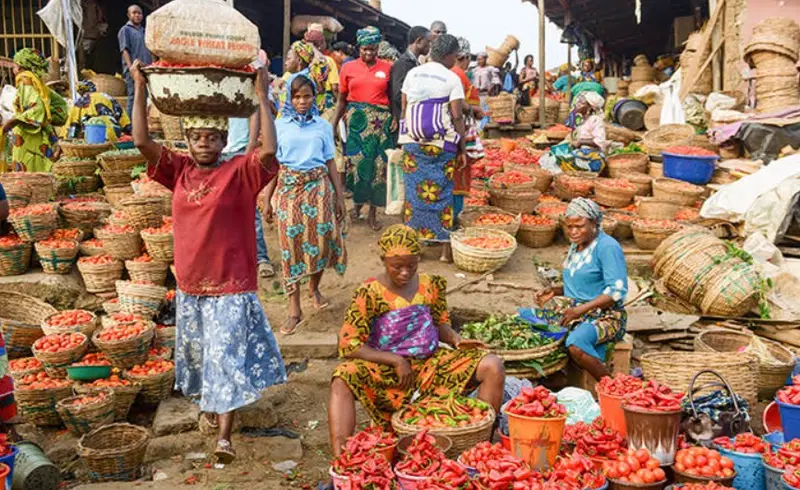
Nigeria’s annual food inflation rate reversed a six-month downward trend, rising to 12.2 per cent in February, from 8.89 per cent in January, going by the Consumer Price Index report for February released yesterday by the National Bureau of Statistics (NBS).
It attributed the increase to a rise in the average price of staple foods and vegetables as per “the average prices of Beans, Carrots, Okazi Leaf, Cassava Tuber, Crayfish, Millet Flour, Yam Flour, Snails, Avenger (Ogbono/Apon) – dried ungrinded, and cow peas.”
The NBS inflation report in January showed that the food inflation rate slumped to its lowest level in 14 years, at 8.89 per cent, the first single-digit rate since August 2011, when food inflation stood at 8.66 per cent. However, in the NBS February inflation report released on Monday, food inflation returned to double digits, climbing to 12.12 per cent, a 3.23 per cent increase from the preceding month.
While the report showed further decline in the annual headline inflation rate to 15.06 per cent in February from 15.10 per cent in January, it, however, showed an increase in the month-on-month (monthly) headline and food inflation rates during the months.
According to the statistics office, “In February 2026, the headline inflation rate eased to 15.06 per cent, down from 15.10 per cent in January 2026.
“Looking at the movement, the February 2026 headline inflation rate showed a decrease of 0.04% compared to the January 2026 headline inflation rate.
“On a year-on-year basis, the headline inflation rate was 11.21 per cent lower than the rate recorded in February 2025 (26.27 per cent). This shows that the headline inflation rate (year-on-year basis) decreased in February 2026 compared to the same month in the preceding year (i.e., February 2025).
Food Inflation Index
On a year-on-year basis, the food inflation rate in the country stood at 12.12 per cent, 14.86 per cent lower than the 26.98 per cent recorded in February 2025.
However, on a month-on-month basis, the food inflation rate in February 2026 was 4.69 per cent, up by 10.70 per cent from January 2026, which was -6.02 per cent.
According to the NBS, the average annual rate of food inflation for the twelve months ending February 2026 over the previous twelve-month average was 19.08 per cent, which was 18.32 percentage points lower compared to the 37.40 per cent average annual rate of change recorded in February 2025.
States’ Inflation Profile
The NBS report also showed that Kogi State recorded the highest headline and food inflation rates of 23.57% and 26.91% respectively in February.
The report stated: “In February 2026, the All-Items inflation rate on a Year-on-Year basis was highest in Kogi (23.57%), Benue (22.85%), and Anambra (22.09%), while Katsina (7.78%), Imo (11.66%) and Ebonyi (11.71%) recorded the lowest rise in headline inflation on a Year-on-Year basis.
“On a Month on-Month basis, however, February 2026 recorded the highest increases in Enugu (5.92%), Ogun (4.39%) and Anambra (4.11%), while Zamfara (-2.14%), Bauchi (-1.23%), and Katsina (-1.06%) recorded a decline in the Month-on-Month inflation.
“Food inflation on a Year-on-Year basis was highest in Kogi (26.91%), Adamawa (23.12%), and Benue (21.89%), while Katsina (5.09%), Bauchi (7.09%), and Imo (7.65%) recorded the slowest rise in Food inflation on a Year-on-Year basis. On a Month-on-Month basis, however, February 2026 Food inflation was highest in Bayelsa (8.81%), Ebonyi (8.51%) and Edo (7.72%), while Katsina (-0.70%).”

