





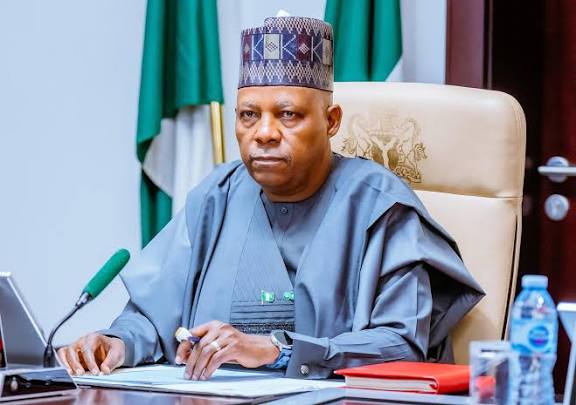
Vice President Kashim Shettima has reaffirmed President Bola Ahmed Tinubu’s commitment to taking full responsibility for the policies and decisions of his administration, stating that the President has deliberately avoided blaming previous governments for the country’s current economic and social difficulties.
Shettima made the remarks while speaking at a public event where he reflected on the administration’s approach to governance, accountability, and national development. According to the Vice President, President Tinubu believes that leadership demands accepting responsibility for the nation’s challenges rather than shifting blame to past administrations, regardless of the circumstances inherited.
The statement comes at a time when Nigeria continues to grapple with rising inflation, high food prices, foreign exchange volatility, unemployment, and growing concerns over the cost of living. Since assuming office, Tinubu’s administration has implemented a series of economic reforms, including the removal of fuel subsidies and the liberalisation of the foreign exchange market. While government officials maintain that these measures are necessary to stabilise the economy in the long term, many Nigerians have continued to express concerns over the immediate impact on households and businesses.
Shettima noted that although the administration inherited significant structural and economic challenges, President Tinubu has consistently maintained that his government was elected to solve problems rather than dwell on the mistakes of previous administrations.
According to him, the President understands that Nigerians expect practical solutions and measurable progress instead of endless political arguments over who is responsible for the country’s current state.
The Vice President explained that every administration inherits both opportunities and difficulties from its predecessor, but responsible leadership requires focusing on building a better future. He added that President Tinubu has repeatedly instructed members of his cabinet to remain focused on delivering results across critical sectors instead of engaging in unnecessary political exchanges.
He said the administration remains committed to implementing reforms aimed at restoring economic stability, attracting investment, improving infrastructure, strengthening security, and creating opportunities for young Nigerians.
Shettima acknowledged that the reforms introduced by the government have required sacrifices from citizens. However, he maintained that these decisions were taken after careful consideration and were designed to prevent deeper economic crises in the future.
According to him, difficult decisions are sometimes unavoidable in governance, especially when a country’s economic foundations require urgent restructuring. He argued that postponing such reforms would only worsen the burden on future generations.
The Vice President stressed that the administration is aware of the hardship currently being experienced by many Nigerians and is working to cushion the effects through various intervention programmes.
He pointed to ongoing investments in agriculture, social welfare initiatives, student support programmes, infrastructure projects, and efforts to expand access to credit for small businesses as part of measures designed to improve livelihoods.
Shettima also emphasised that President Tinubu believes leadership should be judged by actions rather than excuses. He said the President has consistently encouraged ministers and heads of government agencies to remain accountable for their responsibilities while accelerating the implementation of projects that directly benefit citizens.
Observers say the Vice President’s remarks reflect the administration’s broader communication strategy of presenting itself as a government focused on long-term reforms despite public criticism over current economic conditions.
Since the introduction of key policy changes shortly after the administration assumed office, government officials have repeatedly defended the reforms as necessary steps toward achieving sustainable economic growth, fiscal discipline, and improved investor confidence.
Economic analysts remain divided over the pace and impact of the reforms. While some argue that removing long-standing distortions in the economy was inevitable, others believe stronger social protection measures are needed to reduce the burden on vulnerable Nigerians during the transition period.
Many citizens continue to call for faster improvements in electricity supply, job creation, transportation, healthcare, education, and food security as indicators of the reforms’ success.
Political analysts note that Shettima’s comments may also be intended to reinforce public confidence in the administration’s willingness to accept responsibility for governance rather than rely on political rhetoric.
According to them, acknowledging challenges while outlining concrete plans could help strengthen public trust if accompanied by visible improvements in the economy and public services.
The Tinubu administration has repeatedly stated that it remains committed to creating a more resilient economy capable of supporting inclusive growth and reducing dependence on volatile revenue sources.
Government officials have also highlighted ongoing efforts to increase domestic production, expand infrastructure, improve tax administration, attract foreign investment, and strengthen Nigeria’s digital economy.
Despite these assurances, many Nigerians continue to hope that the benefits of the government’s policies will become more evident in their daily lives through lower inflation, stable prices, improved employment opportunities, and increased purchasing power.
As the administration enters another phase of its reform agenda, expectations remain high among citizens who are eager to see tangible improvements in living standards and economic conditions.
Shettima concluded by reiterating that President Tinubu remains fully committed to fulfilling the promises made to Nigerians. He said the administration understands the weight of public expectations and will continue to pursue policies it believes are in the country’s long-term interest, while remaining accountable for the outcomes of its decisions.
His remarks underscore the administration’s position that effective leadership is defined not by assigning blame but by accepting responsibility, making difficult decisions when necessary, and remaining focused on delivering sustainable progress for the nation.

