


The House of Representatives has passed a landmark constitutional amendment bill to decentralise the Nigerian policing architecture and bolster internal security.
The bill, titled “A Bill for an Act to Alter the Constitution of the Federal Republic of Nigeria, 1999 to Provide for the Establishment of State Police and for Related Matters (Sixth Alteration) Bill, 2026,” was approved during consideration at the Committee of the Whole.
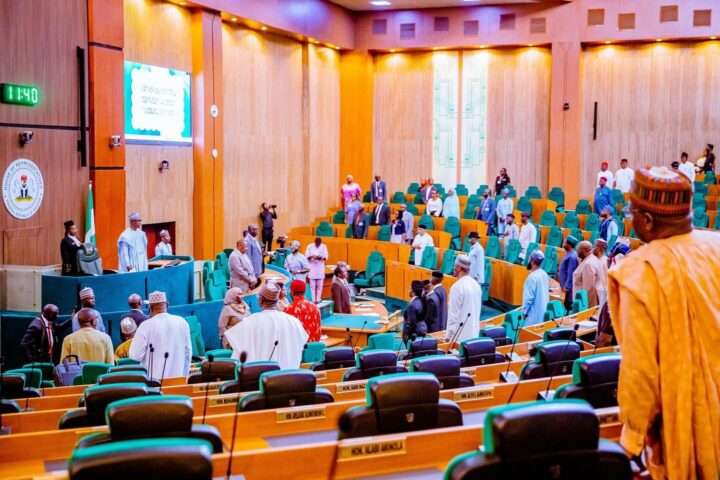
The resolution followed the voting by 289 lawmakers in favour of state police during Thursday’s plenary session presided over by Speaker of the House, Tajudeen Abbas.
One member abstained from the exercise, while none voted against it, reflecting overwhelming bipartisan backing for the far-reaching reform. The Speaker abstained from voting as is the tradition.
Voting commenced after the Deputy Speaker and Chairman of the House Committee on Constitution Review, Benjamin Kalu, presented the report on the proposal and canvassed support from lawmakers.
Kalu had harped on the need for a more decentralised policing framework to effectively address the country’s growing security challenges.
The plenary was not without its fair share of drama, as shortly after the lawmakers settled down for the business of the day, Kaduna lawmaker, Bashir Zubairu, moved a point of order, explaining that the document on the proposed state police put together by the House Committee on Constitution Review got to the lawmakers only on Thursday afternoon.
Recognised to speak by the speaker, Zubairu said, “Mr Speaker, this document was only made available to lawmakers in the chambers, and we are yet to go through it. We cannot do justice to it because we have not gone through it.”
Zubairu, a member of the African Democratic Congress (ADC), was ruled out of order, allowing the process to proceed.
One of the bill’s key provisions amends Section 214 of the 1999 Constitution to formally establish the Federal Police and the State Police. Under the proposal, the National Assembly would be empowered to prescribe the structure, organisation, administration and powers of the Federal Police, while also providing the legal framework and minimum standards for the establishment and operation of state police services.
The bill stipulates that no state police formation shall commence operations unless it is established by a law enacted by the relevant State House of Assembly and certified as complying with national minimum standards prescribed by an Act of the National Assembly.
It further provides that until a state police force becomes operational, the Federal Police shall continue to exercise policing powers and responsibilities within such states.
In a bid to preserve the autonomy of state police formations and prevent undue federal interference, the bill limits federal intervention in states’ internal security affairs. Under the proposal, the Federal Police may intervene only where there is a complete breakdown of law and order, upon the request of a governor or where a state police force becomes unable to function due to administrative, financial or other operational challenges.
The amendment also proposes significant changes to the police’s appointment and command structure.
Under the amended Section 215 of the Constitution, the Inspector-General of Police would be appointed by the President on the advice of the Nigeria Police Council from among serving members of the Federal Police, subject to confirmation by the National Assembly.
Similarly, a State Commissioner of Police would be appointed by a governor on the advice of the Nigeria Police Council from among serving officers of the State Police, subject to confirmation by the respective State House of Assembly.
The bill empowers governors to issue lawful directives to State Commissioners of Police on matters relating to public safety and the maintenance of law and order.
However, where a commissioner considers such directives unlawful or inconsistent with accepted policing standards, the matter may be referred to the Nigeria Police Council, whose decision shall be final.
The proposal also amends Section 84 of the Constitution by replacing references to the “National Police Council and the Federal Police Service Commission” with the “Nigeria Police Council and the Police Service Commission.”