




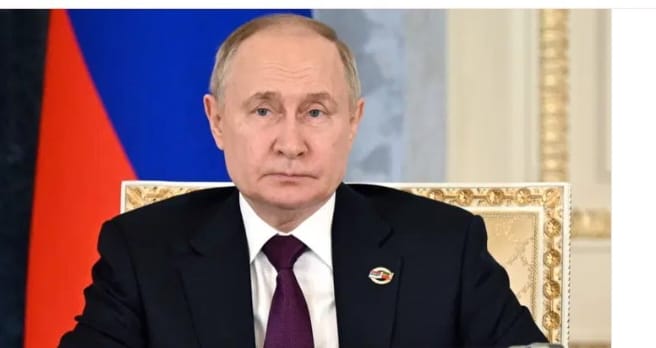
Russian President Vladimir Putin has broken his silence on the tragic crash of an Azerbaijani Airlines plane, which occurred as it attempted to land in Grozny, Chechnya.
Speaking Saturday, Putin admitted that Russian air defense systems were operational at the time, raising questions about whether the plane was accidentally downed.
His remarks came during a phone call with Azerbaijani President Ilham Aliyev, where he expressed condolences and apologized for the incident taking place in Russian airspace.
However, Putin stopped short of directly admitting that Russian forces were responsible for the crash.
The Embraer 190 passenger jet, en route from Baku to Grozny, went down in Kazakhstan three days earlier, resulting in the deaths of 38 people out of the 67 onboard.
Initial investigations and statements from Western experts have pointed to the possibility of the plane being hit by Russian air defense systems. U.S. officials have indicated they possess “early evidence” that the aircraft was shot down.
During the call, Putin explained that the plane had made several attempts to land in Grozny before the crash.
According to the Kremlin’s transcript, he noted that at the time of the incident, Russian air defenses were actively engaged in repelling Ukrainian combat drone attacks targeting Grozny, Mozdok, and Vladikavkaz.
The Russian leader expressed “deep and genuine condolences” to the victims’ families and wished a swift recovery to the survivors.
President Aliyev, however, remained firm in his stance, suggesting the plane was shot down in Russian airspace.
According to a statement from Azerbaijan’s presidency, Aliyev stressed that the passenger aircraft encountered “external physical and technical interference,” which caused it to lose control completely.
He further called for a full investigation to hold those responsible accountable.
The Azerbaijani presidency statement detailed evidence pointing to external interference, including multiple holes found in the plane’s fuselage, injuries sustained by passengers and crew from foreign objects penetrating the cabin mid-flight, and accounts from survivors who reported hearing an explosion before the crash.
One survivor recounted hearing a loud blast just as the aircraft prepared for landing, while others described chaos in the cabin as the plane lost control.
The testimonies have bolstered claims that external interference led to the tragedy.
Aliyev’s office emphasized the need for an independent and transparent investigation, citing the significant physical damage to the aircraft and the corroborating accounts from passengers and flight crew.
“We demand an inquiry to determine the perpetrators and ensure they are brought to justice,” the statement read.
This incident has cast a shadow over Russia-Azerbaijan relations, with both sides expressing differing narratives.
While Putin has expressed regret and sympathy, his acknowledgment of air defense activity near the crash site has fueled speculation about Russian responsibility.
The Kremlin’s guarded response, combined with international calls for accountability, underscores the geopolitical tensions surrounding the incident.
For Azerbaijan, the crash represents not just a national tragedy but a diplomatic flashpoint.
President Aliyev’s firm stance suggests Baku is unwilling to let the matter be swept under the rug, particularly as evidence mounts pointing to external interference.
Meanwhile, international observers and aviation experts will be closely monitoring the investigation, as the outcome could have significant implications for regional security and aviation safety.
The tragedy has also reignited concerns over civilian safety in conflict-affected airspaces, particularly as hostilities between Russia and Ukraine continue to escalate.
As the investigation unfolds, the families of the victims and survivors await answers, hoping for justice amid mounting evidence of a devastating error or miscalculation.

