





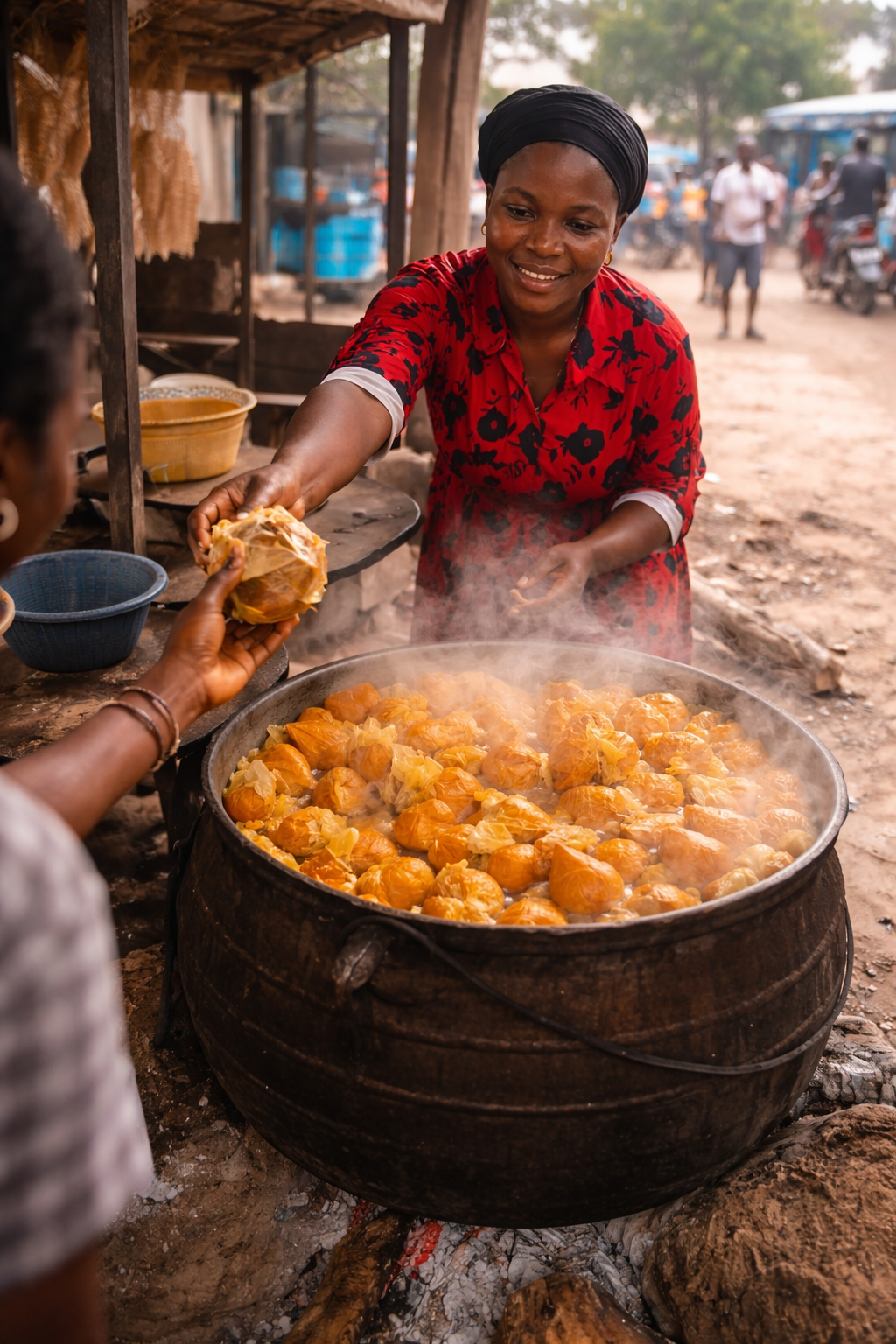
On a busy roadside in Abuja, a woman sits quietly beside a large steaming pot of Okpa. Wrapped in leaves and sold fresh each morning, her product draws a steady stream of customers workers rushing to offices, drivers, traders, and students looking for an affordable, filling meal.
To many passersby, she is just another roadside vendor, part of the everyday background of city life.
But look closer, and her story tells a deeper truth about money, work, and the changing reality of financial stability in Nigeria.
Every day, she prepares about 100 wraps of Okpa, selling each for roughly ₦300. That gives her a daily revenue of around ₦30,000. On good days, she may sell even more. Over a month, her income can approach ₦900,000 and sometimes even cross the ₦1 million mark. After deducting the cost of Bambara nut flour, oil, seasoning, and fuel, she still earns far more than many salaried workers.
Now compare that to the traditional path that has long been promoted as the safest route to success: going to school, earning a degree, and securing a 9-to-5 job. Across Nigeria, many graduates earn between ₦75,000 and ₦250,000 monthly. In cities like Abuja, where transportation, rent, and food costs continue to rise, that income often barely covers basic needs. By the end of the month, little is left to save or invest.
This contrast raises a powerful and uncomfortable question: is the traditional path of education leading to a salaried job still the smartest route to financial stability?
For decades, education has been seen as the key to a better life. Parents invest heavily in their children’s schooling, believing it will open doors to stable employment and long-term security. And in many ways, that belief is still valid. Education builds knowledge, discipline, and critical thinking. It creates opportunities that might otherwise not exist.
However, the economic reality on the ground is shifting.
The number of graduates entering the job market each year has increased significantly, but the availability of well-paying jobs has not kept pace. Many young people find themselves unemployed or underemployed, working in roles that do not reflect their qualifications. Even those who secure jobs often struggle with low wages and limited growth.
At the same time, small-scale businesses especially in the food sector are thriving quietly. The Okpa seller represents a larger segment of Nigeria’s informal economy, where individuals identify everyday needs and meet them consistently. Food is a necessity, and products like Okpa are affordable, nutritious, and widely consumed. This creates a steady demand that does not depend on formal employment structures.
What makes her situation even more striking is perception.
Many people look at her and see “hard labor” or “low-status work.” Some may even feel a sense of pity, assuming she is struggling financially. But in reality, she may be earning more in a single day than some office workers earn in a week. The difference lies not just in income, but in how society defines success.
In Nigeria, there is still a strong cultural bias that associates success with formal employment wearing suits, working in offices, and earning a monthly salary. Meanwhile, informal businesses are often overlooked or undervalued, despite their economic impact. This disconnect leads to a situation where people chase appearances rather than outcomes.
Yet, it would be overly simplistic to conclude that business is always better than a 9-to-5 job.
Entrepreneurship comes with its own challenges. The Okpa seller works long hours, often starting before dawn. Her income depends on daily sales, if she falls sick or demand drops, her earnings are affected immediately.
There are no benefits such as paid leave, health insurance, or retirement plans. The work is physically demanding and requires consistency and resilience.
On the other hand, salaried employment offers stability and structure. Even if the income is lower, it is predictable. Workers can plan their finances around a fixed salary, and some jobs provide additional benefits. For many people, especially those who prefer security over risk, this stability is valuable.
So where does that leave the original question?
The answer lies not in choosing one path over the other, but in understanding that the world has changed. The traditional model education leading directly to financial stability through a single job is no longer guaranteed. Instead, success today often requires a combination of knowledge, adaptability, and strategic thinking.
Education should not be abandoned; rather, it should be redefined. It should equip individuals not just to seek jobs, but to create opportunities. A person who understands basic business principles, financial management, and customer behavior can apply that knowledge in multiple ways, whether in a corporate role or a personal venture.
Likewise, small businesses should not be dismissed as “fallback options.” When approached strategically, they can generate significant income and even grow into larger enterprises. The Okpa seller’s business, for example, could expand through better branding, packaging, or supply to offices and events. What starts as a roadside hustle can evolve into a structured enterprise.
There is also a broader lesson for society.
Respect for work should not be based on appearance or environment. Whether someone is sitting in an air-conditioned office or beside a steaming pot on the roadside, what matters is the value they create and the life they are able to sustain. The Okpa seller feeds dozens of people daily and supports her family through honest work. That, in itself, is a form of success that deserves recognition.
As Nigeria continues to navigate economic challenges, it is becoming clear that financial stability will not come from a single path. It will come from diversification of income, skills, and opportunities. Those who rely solely on one source of income, whether a salary or a small business, may find themselves vulnerable. But those who combine different approaches are more likely to thrive.
The woman selling Okpa in Abuja may never step into a corporate office, but she has built something many aspire to: consistent income, independence, and the ability to provide for her family. Her story is not just about food or business; it is about perspective.
In today’s Nigeria, the smartest route to financial stability is no longer about following tradition blindly. It is about understanding reality, recognizing opportunities, and making strategic choices.
And sometimes, those choices look very different from what society expects.

