






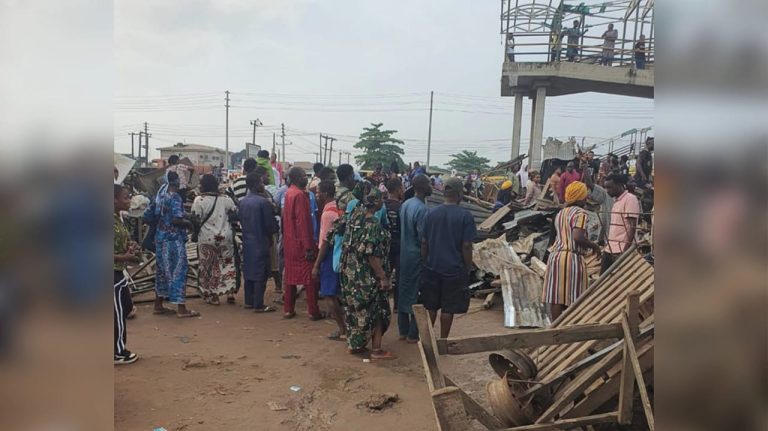
Traders operating at the Mowe/Ofada Market in Obafemi Owode Local Government Area of Ogun State have been left counting massive losses after parts of the popular market were demolished during an enforcement exercise carried out by officials of the state government.
The development has thrown hundreds of business owners into uncertainty, with many claiming they lost goods, equipment and investments accumulated over several years.
The affected traders estimate that the total value of destroyed goods and damaged property runs into more than N500 million, a figure they say reflects the scale of the devastation experienced by families whose livelihoods depend entirely on daily market activities. The incident has sparked concerns about the economic impact on small business owners already struggling with rising inflation, declining purchasing power and increasing operational costs.
At the market, the aftermath of the demolition painted a grim picture. Piles of broken roofing sheets, shattered wooden structures, damaged display shelves and scattered merchandise covered sections of the once-busy trading area. Many traders stood silently beside the remains of their shops, attempting to recover whatever items could still be salvaged from the rubble.
Some business owners were seen gathering damaged goods while others tried to separate reusable materials from debris in the hope of rebuilding temporary stalls. The emotional toll was equally evident as several traders expressed fears about how they would provide for their families following the unexpected loss of their businesses.
According to many of those affected, the demolition came as a shock because they believed they had not been given adequate notice to remove their goods before the exercise began. They argued that while governments have the authority to enforce planning regulations, such actions should be carried out in a manner that protects citizens from avoidable financial hardship.
Several traders insisted that they arrived at the market expecting to begin another normal business day only to discover that their stalls had already been brought down. The situation, they said, left them with little opportunity to rescue merchandise, equipment and other valuable items stored inside their shops.
The traders described the experience as heartbreaking, especially for those who had invested personal savings or borrowed money from financial institutions and cooperative societies to establish their businesses. Many explained that they were still repaying loans used to stock their shops before the demolition occurred.
One affected trader lamented that years of hard work disappeared within hours, saying the business represented the family’s only dependable source of income. She appealed for compassion, arguing that ordinary citizens trying to earn an honest living deserve fair treatment whenever government policies affect their means of survival.
Others echoed similar concerns, stressing that economic realities have already placed enormous pressure on traders across the country. They noted that rising transportation costs, higher prices of goods and reduced customer spending have significantly reduced profit margins in recent months.
The demolition, according to the traders, has now worsened an already difficult situation by leaving many without shops, income or a clear path to recovery. Some said they had no immediate alternative location from which to continue trading, increasing fears that customers built over several years could be permanently lost.
Beyond the physical destruction, the incident has also disrupted commercial activities around the market, with suppliers, transport operators and casual workers equally affected by the temporary shutdown of businesses. Residents who rely on the market for affordable food items and household supplies may also experience inconvenience while trading activities remain disrupted.
Several traders recalled previous interactions with government officials regarding the market and claimed that earlier discussions had created the impression that issues surrounding the area could be resolved through dialogue. They expressed disappointment that the latest enforcement exercise ended with widespread demolition instead of further consultations.
Many insisted that they were willing to cooperate with authorities if given sufficient time to comply with any directives relating to physical planning or market restructuring. According to them, proper communication would have allowed traders to relocate their goods and reduce the enormous losses now being reported.
Community members who visited the market after the demolition sympathised with the affected traders, noting that small businesses play an important role in supporting local economic growth. They urged the government to consider measures that would help the displaced entrepreneurs return to business as quickly as possible.
Some residents argued that while urban development remains necessary, enforcement activities should be balanced with humanitarian considerations, particularly when they affect hundreds of families whose livelihoods depend on informal commerce. They suggested that advance notice, stakeholder engagement and relocation arrangements could help reduce the social consequences of similar exercises in the future.
Business associations within the area also called for constructive engagement between government officials and representatives of the affected traders. They maintained that dialogue remains the most effective approach to resolving disputes involving public markets and commercial spaces.
The traders have appealed directly to the Ogun State Government to provide support that would enable them to rebuild their businesses. Among their requests are the allocation of an alternative trading location, financial assistance for severely affected shop owners and measures aimed at helping small businesses recover from the losses.
Some also appealed for intervention from relevant government agencies responsible for commerce, small business development and social welfare, arguing that assistance would help prevent further economic hardship among families that depended entirely on market trading.
They maintained that restoring their ability to earn a living should be treated as a priority, warning that prolonged displacement could push many households deeper into financial distress.
As discussions continue, attention is expected to focus on how authorities and affected stakeholders can work together to find a lasting solution that balances urban planning objectives with the protection of legitimate businesses and livelihoods.
For many traders at the Mowe/Ofada Market, however, the immediate concern remains survival. With shops reduced to rubble and valuable goods lost, they now face the difficult task of rebuilding their businesses from scratch while hoping that government intervention will provide the relief needed to restore normal commercial activities and protect the economic future of hundreds of families.

