






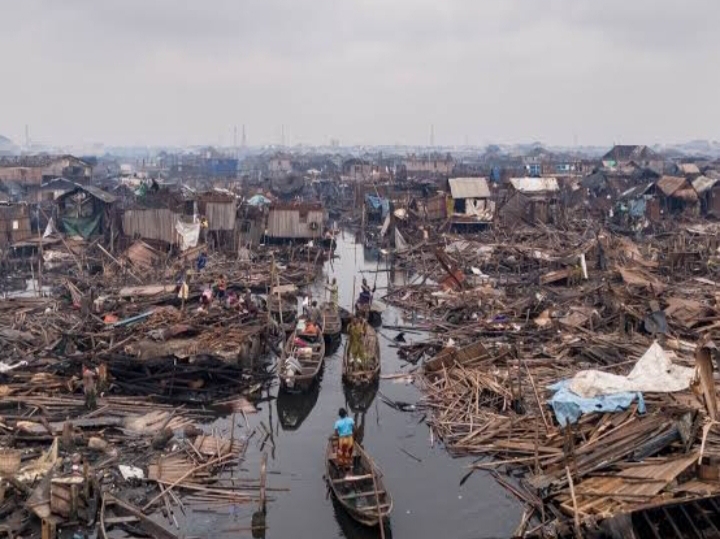
Makoko, a historic floating fishing community in Lagos, is facing a deep humanitarian crisis following an ongoing demolition exercise by the Lagos State Government.
Thousands of residents have lost their homes. Many families, including women, children, widows and the elderly, are now sleeping inside canoes, beside the lagoon or under the open sky.
Rows of wooden houses and shops have been destroyed, leaving behind broken planks, scattered belongings and people struggling to survive.
Makoko, often described as Africa’s largest floating slum, is home to fishermen, traders and artisans whose lives depend on the lagoon. For many residents, the demolition has not only taken away their homes but also their means of livelihood.
Demolition began quietly in December
Residents told DAILY POST that the demolition started quietly in December 2025 before gaining public attention.
According to them, the operation moved gradually from one area to another, with little consultation or warning.
“They started from one side and kept moving closer,” said Mr Sunday Adebayo, a community elder who has lived in Makoko for over 20 years.
“At first, we thought it would stop. But by January, it became massive. That was when we knew they wanted to wipe us out in the name of development. Everything we own is gone,” he said.
Before the demolition, residents survived through fishing, trading and small businesses run from their homes. Today, most of these activities have stopped.
A 35-year-old fisherman, Oyomide, said he can no longer feed his family.
“This water is how we survive. I go fishing every morning, my wife smokes fish and we sell small. But when they destroyed our house, everything was lost. My fishing net was damaged, my canoe almost sank. Since then, we have not eaten well,” he said.
A mother of four said hunger has become part of their daily lives.
“Before, even if money was small, we could find something to eat. Now, there is nothing. No house, no shop, no work. Sometimes my children sleep without food. As a mother, it breaks my heart,” she said tearfully.
Many residents said they lost savings, fishing tools, goods and household items during the demolition.
“They did not give us time to pack anything. My money, mattress, radio—everything is gone,” an elderly man said.
“This is the only home we have known”
Several residents said Makoko is their ancestral home.
A 52-year-old fisherman, Balogun Adekunle, said his family has lived there for over 40 years.
“My father lived here. I was born here. My children were born here. This is the only home we know,” he said.
Mrs Bidemi, a widow with three children, said she has nowhere else to go.
“My husband died five years ago. This house was all we had. Now it has been destroyed. I am alone with my children. Where do they expect us to go?” she asked.
Sleeping in canoes, exposed to rain and mosquitoes
Displaced residents said the Lagos State Government has not provided any temporary shelter or IDP camp.
When it rains, they get soaked. Under the sun, there is no shade. At night, mosquitoes attack freely. Mothers hold their children tightly inside wooden boats.
“If rain falls, it beats us. If sun comes, it burns us. Mosquitoes don’t spare anyone. They destroyed my shop. How will my children eat?” one woman said.
A father of five said his children now fall sick regularly.
“My children cough every night because of the cold. We have no roof again. I don’t know what tomorrow will bring,” he said.
Some residents said relatives could not accommodate them because they have no money to contribute to feeding.
Allegations of night demolitions and fires
Residents also alleged that some demolitions were carried out at night.
“One night, after midnight, bulldozers came while people were sleeping. Children were crying. Nobody listened to us,” said Mr Adekunle Hassan.
Others claimed that some houses were set on fire.
“They burned houses while people were still inside

