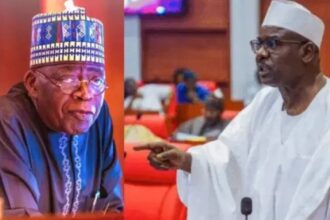




The Deputy Speaker of the House of Representatives, Benjamin Kalu, has narrated how he met with the Director-General of the fictitious Presidential Foreign Intervention Promotion Council (PFIPC), Prince Adeniyi Adeyemi, describing the engagement as a sophisticated impersonation scheme.
“I was a victim, and I’m sure if you watch the news, you would see my picture all over the screen standing side by side with the purported Director-General of this organisation,” the Abia State-born politician said.
The PFIPC allegedly presented itself as an agency under the Presidency despite lacking legal recognition. At the centre of the controversy is Adeniyi Adeyemi, who claimed to be the Director-General of both the PFIPC and the Presidential Economic Advisory Council (PEAC).
Adeyemi and his associates reportedly attended official functions and engaged with public institutions using stationery that suggested they represented the Presidency. The Presidency has since distanced itself from both Adeyemi and the two organisations.
In a statement, the Chief of Staff to the President, Femi Gbajabiamila, confirmed that neither the PFIPC nor the PEAC exists under President Tinubu’s administration and clarified that Mr Adeyemi was never appointed to head any such body.
Speaking during Wednesday’s plenary on a motion seeking an investigation into the organisation’s alleged inclusion in the 2026 Appropriation Framework, Kalu stated that photographs of his meeting with the group’s leader were widely circulated in the media, creating the false impression that the organisation enjoyed official recognition.
“I rise this morning to support the motion that has been properly moved by my friend and brother from Plateau State. It is quite embarrassing that people have the kind of boldness exhibited, moving around with what is not in existence, carrying themselves as if they are a legal entity,” he said.
The Deputy Speaker explained that his office had received a letter dated 2 May 2025 from an entity identifying itself as both the Presidential Economic Advisory Council (PEAC) and the PFIPC.
He noted that the correspondence bore the Presidency’s insignia, cited an address at the Federal Secretariat Complex, Phase Three, Abuja, and included what appeared to be an official government website—details that led his team to believe the organisation was a legitimate government body.
“I sent my team to verify the existence of this organisation at the stated address. They came back confirming that the organisation was operating from that location,” he told his colleagues.
Following this verification, Kalu approved a meeting with the delegation, believing they were there to discuss the ongoing constitutional amendment process, legislative priorities to boost investor confidence, and potential collaboration between the National Assembly and the council. Red flags and misplaced priorities
However, the meeting did not go as expected. The deputy speaker noted that instead of engaging in substantive policy discussions, the delegation appeared primarily interested in taking photographs with him.
“They did not talk about the constitutional amendment that we were undertaking. They did not discuss the issues they listed in their letter. They were more interested in taking photographs,” he remarked.
This conduct immediately raised suspicions regarding whether they were genuinely acting on behalf of President Bola Tinubu’s administration. Reflecting on the incident, Kalu warned that official-looking documents, government logos, and physical addresses are no longer sufficient proof of legitimacy.
“This goes to show that a beautiful letterhead bearing the Presidency is no longer sufficient confirmation that an agency is legitimate. It also shows that an address at the Federal Secretariat does not necessarily mean an organisation is legally established,” he said. Parliamentary inquiry.
The Deputy Speaker argued that the incident highlights the need for stronger institutional safeguards to prevent individuals from exploiting government symbols and infrastructure to gain access to public officials. He asserted that the House has a constitutional responsibility, under Sections 88 and 89 of the Constitution, to investigate how the organisation allegedly secured office space within the Federal Secretariat, interacted with senior officials, and reportedly found its way into the federal budget.
“I’m happy this matter has come before Parliament. We owe Nigerians a duty to get to the root of this issue and demonstrate that we stand for transparency and accountability in governance,” he added.
The House subsequently adopted the motion and directed that an ad hoc committee be constituted to investigate the alleged inclusion of the PFIPC in the 2026 Appropriation Framework.