




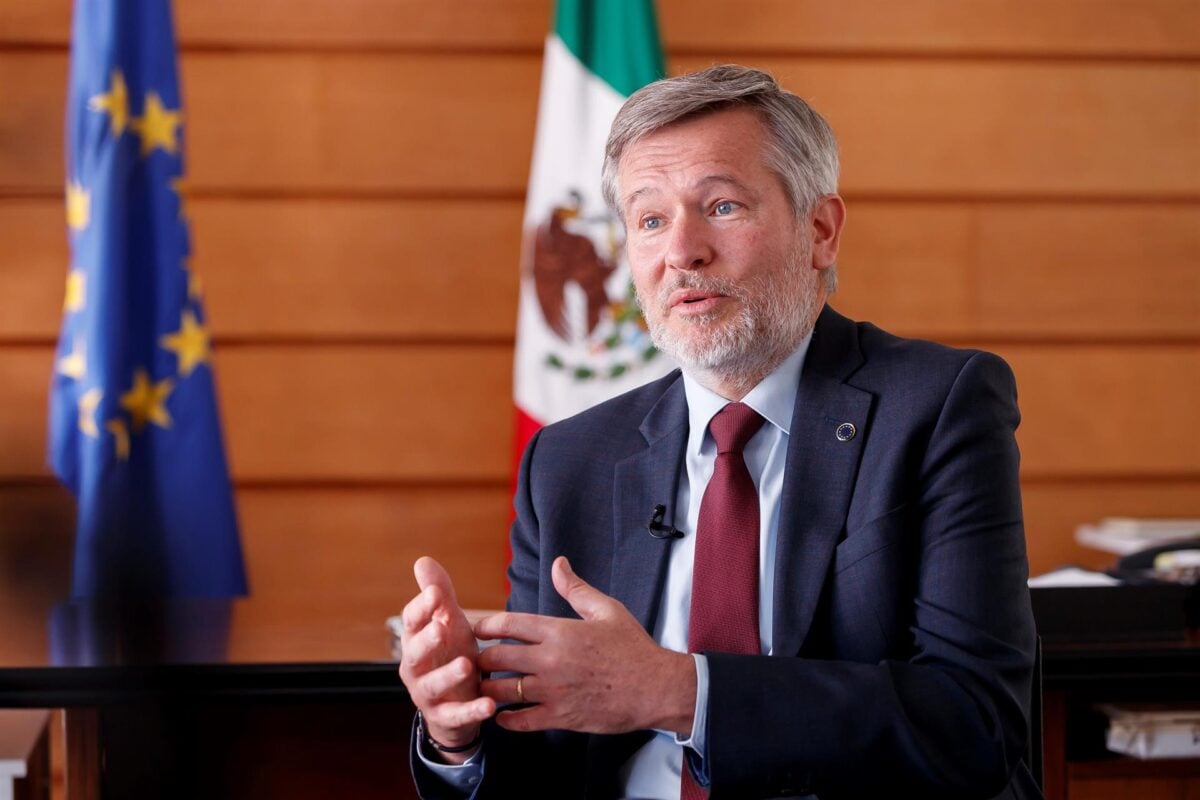
The European Union (EU) ambassador to Nigeria and ECOWAS, Gautier Mignot has reiterated that Russia has been recruiting Nigerians and other Africans to fight its war against Ukraine.
Mignot spoke on Tuesday during the Channels Television’s The Morning Brief as the Russia-Ukraine war marks its fourth anniversary.
Earlier this month, a Nigerian citizen, Abubakar Adamu, sent an SoS to the federal government to urgently move for his repatriation from Russia over claims that he was lured into the Russian army under the guise of employment as a security guard.
Adamu’s legal representatives said he travelled to Moscow on a tourist visa issued on October 16, 2025, by the Russian embassy in Abuja.
 When he arrived in Russia, his travel documents were reportedly confiscated and he was forced to sign enlistment papers written entirely in Russian language, without an interpreter.
Adamu later discovered that he had been enlisted into the Russian army.
Adamu’s appeal came as investigators uncovered dozens of cases of Africans allegedly recruited by the Kremlin into the war.
Last week, a CNN investigation unearthed how Africans from Ghana, Nigeria, Kenya and Uganda were reportedly lured to Russia after on the guise of civilian job offers such as drivers or security guards.
Most said they were promised a signing bonus of $13,000, monthly salaries as high as $3,500, and Russian citizenship at the end of their service.
But when they landed in Russia, they were allegedly forced into the military and given little training before being deployed to the frontline.
They were reportedly made to sign military service contracts in Russian without lawyers or translation provided. Some alleged that their passports confiscated, effectively making it impossible to flee.
Reacting to the reports, Mignot disclosed that women have also been caught in the reported shady deals.
“There is another important phenomenon which is impacting Africa, which is recruitment of African men and women by Russia. Women to be sent and work in military plants in Russia and men to be sent as cannon fodder on the front. Of course they are being lured with job promises,” he said.
The envoy said the EU had received testimonies for “quite some time” but noted that the validating global reports by civil society organisations showed that the situation is “a growing phenomenon”.
“Russia is also running out of soldiers… and this is extremely cruel sending these people, who have absolutely nothing to do with this war, to die on the front,” he said
Mignot maintained that some recruits have already been captured by Ukrainian forces.
Top Society recalls that the Defence Intelligence of Ukraine had announced the discovery of the bodies of two Nigerians in its Luhansk region, who were allegedly fighting on Russia’s side in the ongoing war.
The Nigerians identified as Hamzat Kazeem Kolawole, 42, and Mbah Stephen Udoka, 38, died in late November 2025 — few months after joining the Russian army.
The Russian ambassador to Nigeria, Andrey Podyelyshev called a press conference in Abuja to deny the allegations, saying “There is no government supported programme to recruit Nigerians to fight in Ukraine. So if there are some illegal organisations, some illegal people who are not abiding by the law, if they are trying to recruit Nigerians to fight in Ukraine by any unlawful means, this is not connected to Russian state.”
However, Mignot noted that testimonies from African recruits support the claims and said Russia’s denial reflects an unwillingness to stop the practice.
The Nigerian government has warned citizens against illegal recruitment into foreign armed conflicts, citing rising cases of Nigerians allegedly being lured abroad under false pretences and forced into combat roles.
The federal government said it is engaging domestic and international partners to investigate the recruitment networks and raise public awareness about the dangers of such schemes.

