






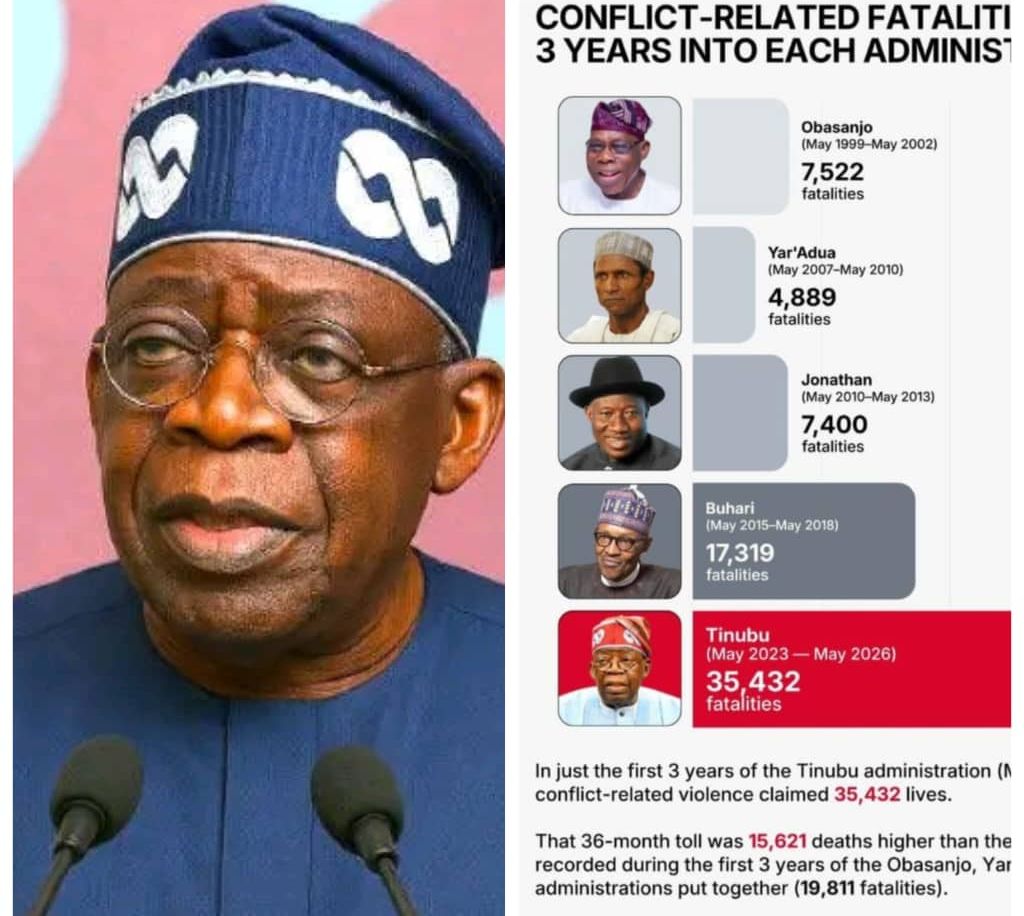
Nigeria’s security situation has continued to attract national and international attention, especially concerning reports suggesting that the country is experiencing high levels of conflict-related deaths during the current democratic administration.
Recent discussions have been fueled by a headline claim that the administration of President Bola Ahmed Tinubu may have recorded one of the highest conflict death tolls in the early years of any democratic government in Nigeria’s history.
While such claims are widely circulated in media and online platforms, they are often based on interpretations of data from different conflict monitoring organizations, rather than a single official national statistic. This makes the subject both sensitive and complex, requiring careful context to understand what the numbers actually represent and what they do not.
Nigeria has faced multiple overlapping security challenges for more than a decade. These include insurgency in the North-East, banditry in the North-West, communal clashes in parts of the North-Central, and sporadic outbreaks of violence in other regions. Each of these crises contributes differently to the overall level of insecurity, and they are often recorded separately by researchers and humanitarian organizations.
One of the key difficulties in assessing conflict-related deaths in Nigeria is the lack of a unified national database that consistently tracks all violent incidents across the country in real time. Instead, most available figures come from international monitoring groups, local reports, civil society organizations, and media investigations. These sources often use different methodologies, timeframes, and definitions of what constitutes a conflict-related death.
As a result, comparisons across different administrations can be challenging. For example, some datasets may include only deaths linked to terrorism and armed insurgency, while others may also include bandit attacks, communal clashes, kidnappings that result in fatalities, and even political violence. This difference in classification can significantly affect overall figures.
Supporters of the claim that conflict deaths have increased under the current administration often point to the persistence of insecurity across several regions and the continued activity of armed groups. They argue that despite ongoing military operations and security reforms, violence has not been fully contained, and in some areas, attacks remain frequent and deadly.
On the other hand, analysts who caution against direct comparisons argue that Nigeria’s security crisis did not begin under the current administration. They note that many of the armed groups responsible for violence have existed for years, and that the structural conditions fueling insecurity such as poverty, unemployment, weak governance in remote areas, and porous borders are long-standing issues.
They also emphasize that changes in reporting capacity can influence perceived trends. In recent years, digital reporting tools, satellite tracking, and increased media presence in conflict zones have improved the visibility of incidents that might previously have gone undocumented. This can make recent figures appear higher even if the underlying rate of violence has not dramatically changed.
Another important factor is population growth. Nigeria’s population has increased significantly over the past two decades. This means that even if the rate of violence remained stable, the absolute number of incidents and casualties could still rise. This makes raw death toll comparisons between different time periods less straightforward.
Furthermore, regional variation plays a major role. The North-East continues to experience insurgency-related violence, while the North-West has seen a rise in banditry and kidnapping networks. In contrast, some southern regions experience lower levels of large-scale conflict but may still face localized communal disputes. These regional differences affect national totals and complicate simple comparisons between administrations.
It is also important to consider the nature of conflict reporting itself.
Organizations that track violence often revise their figures as new information becomes available. This means that numbers published at one point in time may later be updated, corrected, or expanded. In some cases, earlier underreporting is adjusted when more data is verified, which can lead to apparent increases in later years.
Government responses to insecurity have included military operations, intelligence restructuring, community policing initiatives, and collaboration with regional partners. However, the effectiveness of these measures is frequently debated. While some areas have seen temporary improvements in security conditions, other regions continue to experience recurring attacks.
Public perception of insecurity is also shaped by visibility. High-profile attacks, mass casualty events, and viral videos on social media can influence how citizens perceive the overall security situation, sometimes making conditions feel more severe even when trends vary by region and time period.
In discussing claims about the highest conflict death toll among democratic administrations, experts generally caution against definitive rankings unless all datasets are standardized and verified across identical categories. Without consistent methodology, such rankings risk oversimplifying a highly complex reality.
What can be said with greater certainty is that Nigeria continues to face significant security challenges that have resulted in substantial loss of life over multiple administrations. The persistence of these challenges highlights the depth of the underlying issues and the difficulty of resolving them quickly.
Ultimately, the debate surrounding conflict death tolls under the current administration reflects broader concerns about national security, data transparency, and public accountability. It also underscores the need for improved conflict tracking systems that can provide clearer, more consistent information for policymakers, researchers, and the public.
As discussions continue, analysts stress the importance of focusing not only on comparative figures but also on practical solutions that address the root causes of violence. These include strengthening local governance, improving economic opportunities in vulnerable regions, enhancing intelligence coordination, and investing in long-term peacebuilding strategies.
Until such systems are fully in place, interpretations of conflict data will likely remain contested, with different stakeholders drawing different conclusions from the same set of figures.

