





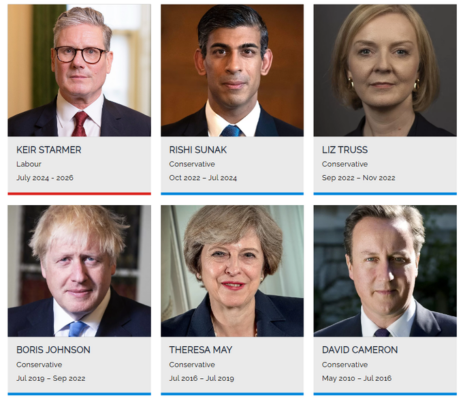
The United Kingdom has experienced a remarkable period of political change over the past decade, with six individuals serving as prime minister amid some of the country’s most challenging political and economic moments.
From the Brexit referendum to the COVID-19 pandemic and the cost-of-living crisis, successive governments have faced significant tests that reshaped Britain’s political landscape and influenced leadership transitions at the highest level.
The period began with David Cameron, who served as prime minister from 2010 until 2016. Cameron led the Conservative Party through a coalition government and later a parliamentary majority. His administration focused on economic recovery and reducing government spending following the global financial crisis. However, his tenure became most closely associated with the 2016 referendum on Britain’s membership of the European Union.
After voters backed leaving the EU, Cameron resigned, arguing that new leadership was needed to guide the country through the next phase of its political journey.
Theresa May succeeded him during a period of deep national division. Her government spent years attempting to negotiate and secure parliamentary approval for Brexit arrangements. Despite multiple efforts to build consensus, her proposed agreements repeatedly faced resistance in Parliament. Growing political pressure eventually led to her resignation in 2019.
Boris Johnson then took office with a pledge to complete Brexit and move the country beyond years of political uncertainty. His government oversaw Britain’s formal departure from the European Union in January 2020. Johnson’s premiership was also defined by the COVID-19 pandemic, one of the greatest public health emergencies in modern times.
While his government implemented extensive measures to manage the crisis, Johnson later faced mounting criticism over several controversies, including allegations surrounding gatherings held during pandemic restrictions. He resigned in 2022 after losing support within his party.
Liz Truss succeeded Johnson but served for only a brief period. Her economic programme triggered significant market reactions and political turmoil, leading to a rapid loss of confidence among lawmakers. After just 45 days in office, she stepped down, recording one of the shortest premierships in British history.
Rishi Sunak took over at a time when restoring economic and political stability had become a priority. His administration focused on inflation, public finances, immigration policy and broader economic challenges. Despite efforts to steady the government, the Conservative Party faced increasing electoral pressure after more than a decade in power.
The 2024 general election brought a major political shift, with the Labour Party returning to government under Keir Starmer. His administration pledged reforms aimed at improving public services, strengthening economic growth and rebuilding confidence in public institutions.
Recent reports circulating online have suggested that Starmer may have resigned in 2026, potentially paving the way for another leadership transition. However, such reports have not been independently verified at the time of writing, and readers are advised to await official confirmation from the British government or credible international news organisations.
Regardless of the outcome, the fact remains that Britain has witnessed an unusually high turnover of political leaders over the last decade. The rapid succession of prime ministers reflects a period marked by extraordinary political challenges, changing public expectations and ongoing debates about the country’s future direction.
As Britain continues to navigate domestic and international pressures, questions about leadership, governance and long-term stability remain central to its political conversation.
The events of the past ten years have demonstrated how quickly political fortunes can change and how profoundly national events can reshape a country’s leadership landscape.

