



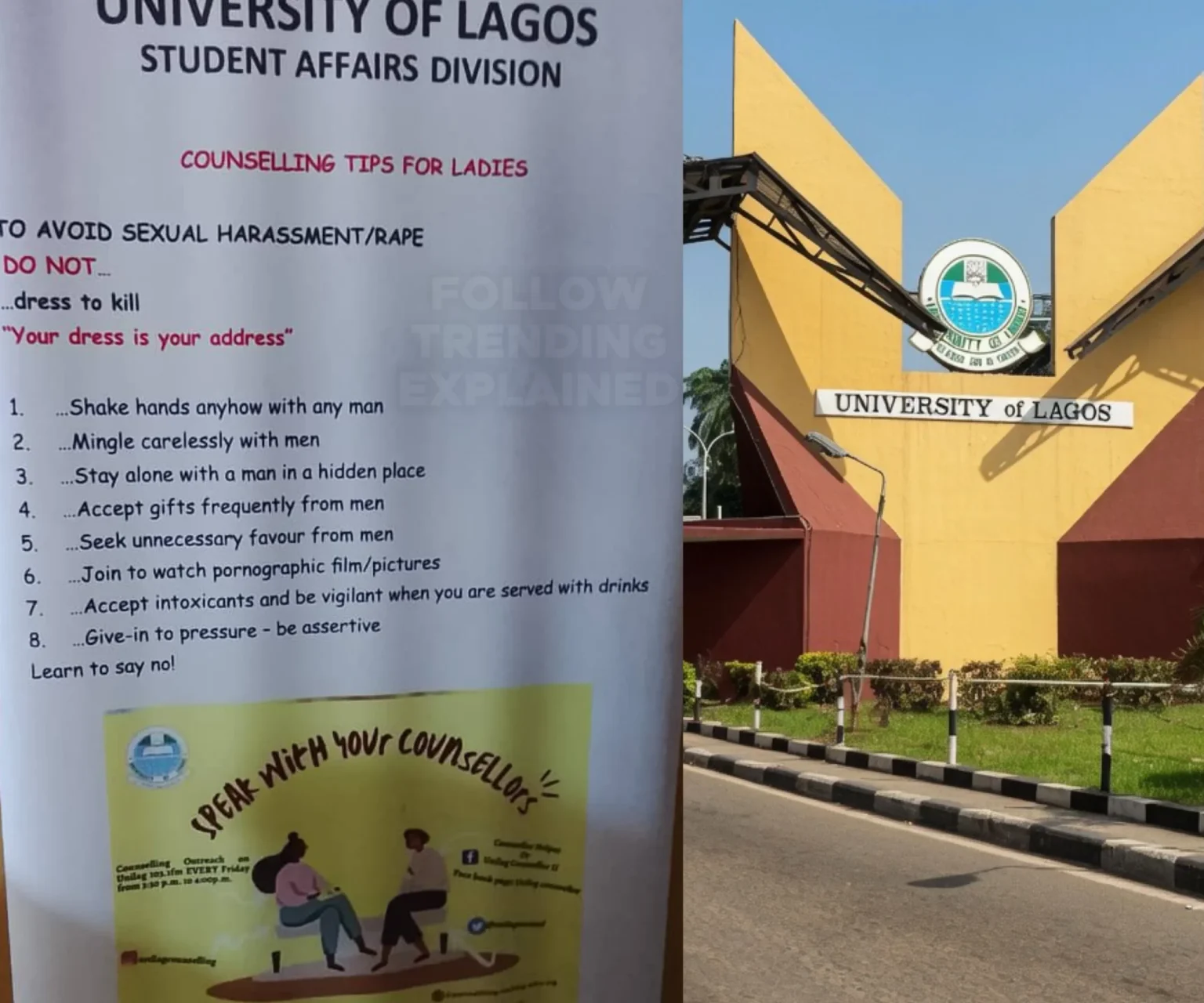
Coming as part of its panacea for incessant cases of assault and rape, the University of Lagos has issued a set of counselling tips for female students aimed at preventing sexual harassment and rape on campus.
The counselling guide, authored by its Student Affairs Division, is displayed on a roll-up banner within the university, advised female students to be dressed decently to avoid rape and sexual harassment.
The banner urges female students to adopt precautionary measures, with one of its most prominent messages reading: “Do not shake hands anyhow with any man.”
Other safety tips on the banner state, “Do not dress to kill. Do not shake hands anyhow with any man. Do not mingle carelessly with men. Do not stay alone with a man in a hidden place. Do not seek unnecessary favour from men. Do not join to watch pornographic film/pictures. Do not accept intoxicants and be vigilant when you are served with drinks. Do not give in to pressure – be assertive.
“Learn to say no. One-time sex can cause you pregnancy; if you don’t want it, don’t try it.”
According to the Student Affairs Division, the guidance forms part of its counselling efforts to educate female students on personal safety and ways to reduce the risk of sexual harassment and rape while on campus.
However, the Students’ Union Government (SUG), led by Bolaji Akinpelu, issued a statement on Saturday to express concerns with the material, and reminding UniLag that “responsibility lies solely with the perpetrator”.
“We are therefore concerned that aspects of the material may be interpreted as suggesting that survivors of sexual harassment or sexual violence bear responsibility for the actions of perpetrators.
“Awareness campaigns should empower students with practical safety knowledge without implying that a survivor’s clothing, appearance, choices, or circumstances either cause sexual violence or reduce the responsibility of the perpetrator,” the SUG contended.
The University of Lagos has, in recent years, recorded incidents of sexual assault and rape within its community, prompting various awareness and counselling initiatives targeted at promoting students’ safety.