



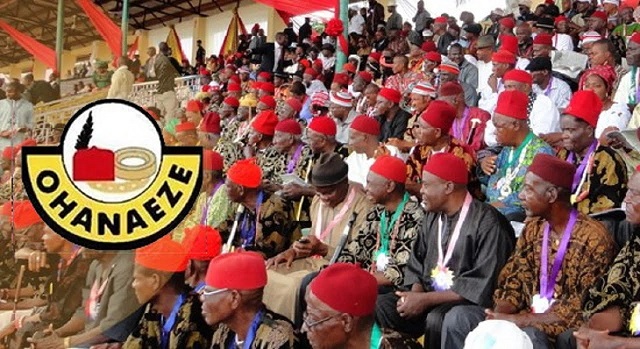
The apex Igbo socio-cultural organisation, Ohanaeze Ndigbo Worldwide on Thursday announced the proscription of conferment and use of the title “Eze Ndigbo” outside Igboland, stating that it would formally notify state governments and embassies around the world of its position.
The President-General of Ohanaeze, Chief John Azuta-Mbata, announced the decision during the Ohanaeze Ndigbo Worldwide Imeobi/General Assembly meeting in Enugu, describing such titles outside Igboland as alien and proscribed.
He warned that violators will face sanctions to be determined by traditional authorities said the ban followed extensive consultations, including a joint meeting of the National Executive Committee (NEC) of Ohanaeze and the leadership of the Southeast Council of Traditional Rulers.
Azuta-Mbata stated that the group would formally communicate its position to state governments and diplomatic missions worldwide.
According to him, “The South-East is proscribing the award of the title of Eze Ndigbo outside Igboland.
“Anybody who is conferred with such a title outside Igboland is on his own. It is unknown to the Igbo people.”
The Ohanaeze President-General stressed that the decision was final and binding, adding that any such title conferred outside the South-East would no longer be recognised by the Igbo nation.
He disclosed that consultations are ongoing with traditional rulers across Igboland to determine appropriate sanctions for defaulters.
Enforcement, he noted, would be carried out through community structures, including town unions and local leadership.
Also speaking, the Minister of State for Foreign Affairs, Bianca Odumegwu-Ojukwu, called for strict sanctions to curb the crises generated by the installation of “Eze Ndigbo” in the diaspora.
According to her, certain cultural practices have sparked tensions in countries such as Ghana and South Africa, as well as other parts of the African continent.
“We’re dealing with a crisis that threatens to undermine our cultural identity and even social cohesion within the communities where we reside outside the country,” she said.
She cited incidents in Ghana and South Africa where such practices triggered tensions, sometimes leading to threats against the lives and property of Nigerians abroad.
Odumegwu-Ojukwu warned that flamboyant displays of self-styled kingship in foreign countries often provoke hostility and undermine the goodwill built by law-abiding Nigerians in host communities.
She described the trend as a cultural crisis threatening identity, cohesion, and peaceful coexistence.
The minister commended Ohanaeze for taking decisive action, noting that the ban would help restore order and foster respect for host communities’ traditions and institutions.
In his remarks, the Chairman of the South East Council of Traditional Rulers, HRH Emmanuel Okeke, said the actions of some individuals had portrayed Igbos as troublesome in foreign lands.
“Igbos should stop using money to cause trouble in the name of Eze Ndigbo in the states and countries they reside,” he said, pledging the council’s support in addressing the trend.
The socio-cultural group also decried continuous imprisonment of the leader of the Indigenous People of Biafra, (IPOB), Nnamdi Kanu, describing it as “tantamount to the jailing of the entire Igbo”.