




The Catholic Bishops’ Conference of Nigeria (CBCN) on Tuesday delivered a blunt assessment of the country’s political and security situation to President Bola Tinubu, warning that Nigeria is steadily drifting towards a one-party state, with democratic institutions, public confidence, and national unity increasingly under strain.
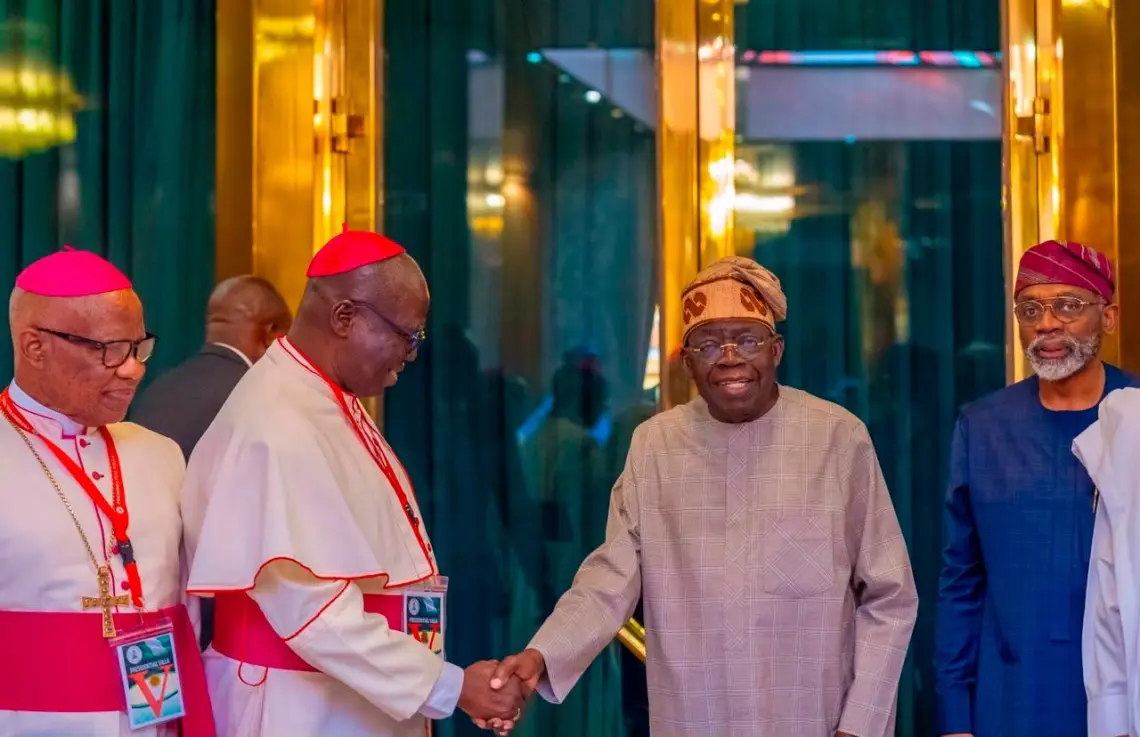
The warning was delivered by the newly elected President of the CBCN, Archbishop Matthew Man-Oso Ndagoso, who led a delegation of Catholic bishops to the Presidential Villa, Abuja, where they held talks with the President on the state of the nation.
Speaking on behalf of the bishops, Ndagoso said growing concerns over the shrinking political space and the weakening of opposition parties have fuelled widespread fears that Nigeria’s hard-won democracy is being eroded.
He reminded President Tinubu of his own pro-democracy credentials, recalling his role in the struggle against military dictatorship in the 1990s, which forced him into exile.
According to the Archbishop, many Nigerians now find it troubling that the democratic ideals for which Tinubu once fought appear to be under pressure.
“Many voices are screaming over what they consider to be the constriction of the political space,” Ndagoso said, adding that many citizens believe the country is gradually being steered towards a one-party state.
He stressed that only President Tinubu’s actions—not assurances—would convince Nigerians that such fears are unfounded.
The bishops urged the President to rein in officials of the ruling party, including governors, members of the National Assembly and local government chairmen, insisting that the All Progressives Congress (APC) must demonstrate respect for democratic values and the rule of law.
According to Ndagoso, Tinubu’s enduring legacy should not be the weakening of political opposition but the strengthening of democratic institutions capable of outliving any administration.
The Catholic leaders warned that the perceived narrowing of political competition could further undermine confidence in future elections.
Expressing concern over declining voter participation, they noted that many Nigerians have become disillusioned with the electoral process because they no longer believe their votes count.
To restore public trust, the bishops called for adequate funding and institutional independence for the Independent National Electoral Commission (INEC), insisting that the 2027 general elections must be free, fair, transparent and credible.
They cautioned that any electoral process lacking integrity would deepen public cynicism and pose a serious threat to Nigeria’s democratic stability.
Beyond politics, the bishops painted a grim picture of the country’s security and socio-economic conditions.
They lamented the worsening wave of insecurity, citing persistent attacks by terrorists, bandits and other armed groups on schools, churches, farming communities and major highways, often without swift or decisive response.
The delegation also expressed deep concern over the nation’s economic hardship, rising cost of living, and the persistent crisis in the electricity sector, which they described as nearing collapse.
Ndagoso further raised concerns over the state of religious freedom, particularly the security challenges confronting Christian communities in parts of northern Nigeria.
He argued that the country’s political, economic and security challenges are deeply interconnected, warning that a weakened democratic space makes it increasingly difficult for citizens and institutions to hold government accountable.
The bishops urged the Federal Government to take urgent and decisive steps to rebuild public confidence, strengthen democratic institutions and address the nation’s mounting security and economic challenges before they further threaten Nigeria’s unity and stability.

