



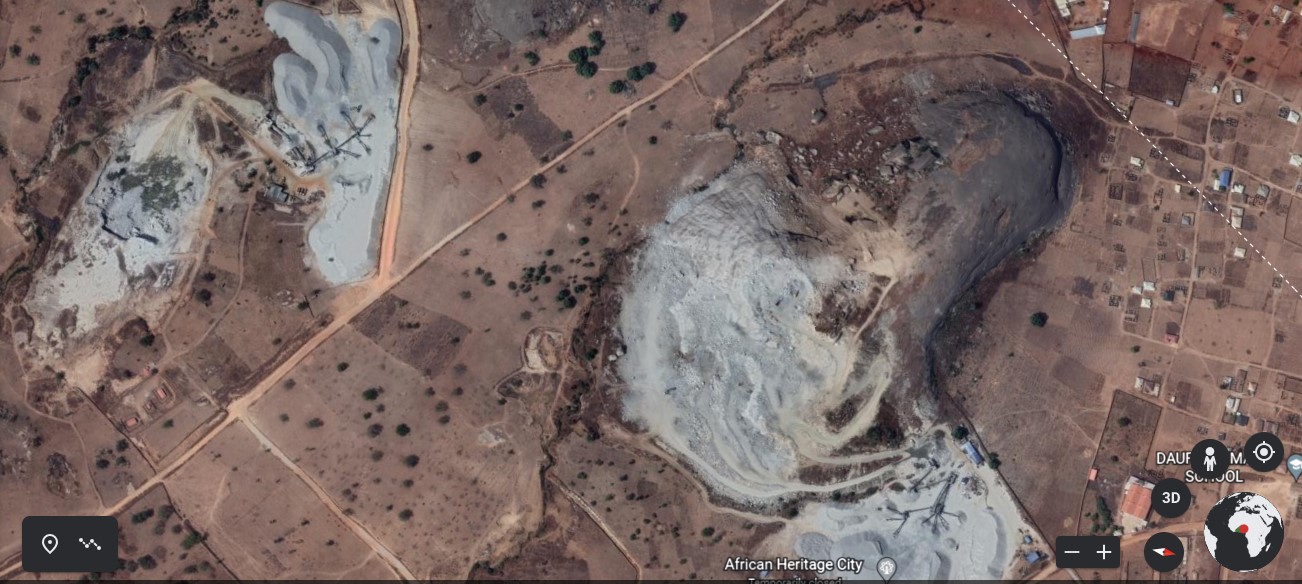
The decades-old activities of quarry companies who dig, blast and tear the ground for money-spinning minerals are becoming unbearable for residents of some parts of the Federal Capital Territory (FCT) who now complain that their lives are being made miserable.
Meanwhile, Quarry Owners Association of Nigeria disclosed last November that quarry operators usually operate in non-residential areas due to the nature of their activities, but immediately after starting operations, houses start springing up close to their sites.
According to the President of the association, Alhaji Nasir Ibrahim, regulations guiding their operations had stipulated the required distance they were supposed to maintain from residential areas to avoid risks such as flying rocks during major blasting, and vibrations, among others.
“When you talk, most of the people say they are the owners of their lives. They have gotten the land from the landowners, so this is the land they have and they have to build their houses there,” he said.
It is claimed that there is an intensified excavation of the land for its ‘gold’ which is pushing residents away from their comfort zone as the ‘invaders’ take over and establish their footprints, with no intention to give way, even in the near future. Vanguard newspapers reports the following findings:
From Mpape, the ‘traditional headquarters’ of quarry operators, to Bmuko, Kubwa, Karshi and Pyakasa, it has been the same story of pollution – air and noise.
For Olatide Yusuf, a youth corps member in Bmuko, a fast-growing community off the Dutse-Bwari road, although her house is not close to any of the quarry sites, she is concerned about the air quality in the area.
According to her: “I deliberately didn’t take a house close to the quarry. However, we still hear the sounds, even here. If you didn’t know, sometimes you would think there has been a truck accident.
“Then the road not being fixed is another pollution, dust. If you put on black, it will turn to white, because the remains of the rocks they break, that is like sand, they will use it to fill the road and it will be raising dust. If you are going out without nose masks, then you will surely have catarrh. And it is worse when the company’s trucks are moving.”
Venus Mining Company and Istanbul Concrete Limited are very active in the area and their operations continue into night time.
Another resident, Ibrahim Auwal, urged the companies to put the road in order. He said even though the companies sometimes wet the road, the weather condition and volume of vehicular traffic on the route is such that it dries off in less than an hour.
“They will only pour water on the road at some specific time. It is only during rainy season that the situation is manageable for the residents because the rains will force the companies to reduce their operations and that automatically reduces the level of dust generated from the quarry. As a result, the road will remain wet for some time. But dry season like now is very challenging for everyone living around the quarry site because the dust generated is unbearable,” he said.
On one of the weekends that the newspaper visited the area, a water tanker from the Venus Quarry was seen spraying water on the dusty road around 11am.
Another corps member, who gave her name simply as Mercy, lamented the ordeal she faces in Jikoko, a community in Mpape.
“Whenever I have to go for my CDS, I have to wear another cloth on top of my NYSC vest. I also put my white sneakers inside a bag. The first time I went for CDS, I got there looking so unkempt because of the dusty terrain from Jikoko to Berger Quarry junction. You have to use face or nose masks and also cover your hair, otherwise you will have respiratory issues and develop what I can refer to as temporary artificial grey hairs,” she said.
Simply put, quarrying is the blasting, extraction, breaking, crushing, cutting, grading, and washing of rocks for use in the built sector. In the process, experts say some of the gases emitted include Sulphur dioxide, Nitrogen dioxide, Chlorine, Carbon monoxide and others, which most times go beyond the limit approved by the National Environmental Standards Regulatory and Enforcement Agency (NESREA).
Aside that, there could be cases of visual assault occasioned by dust and smokes, heavy traffic, noise pollution and sometimes, deterioration in water quality.
Following series of earth tremors in Mpape, which is home to no fewer than nine quarry sites, a few of which are no longer active, the Federal Capital Territory Administration FCTA had in 2018 placed a temporary ban on quarrying in the area.
The Administration had said preliminary reports indicated that rock blasting by quarry operators, other mining activities and proliferation of borehole drilling were the immediate causes of the tremor.
The latest earth tremor in the area occurred from Friday, September 13, to Monday, September 16, 2024, a development that forced some residents to relocate.
Aisha Mohammed, who had lived in the Ajegunle area of Mpape since 2006, said she had to leave the area when her rent expired in November 2024.
“There have been series of earth tremors in the past but what we experienced in 2018, 2020 and the latest one in September 2024 were something else. So, since they do not want to put a stop to quarrying, some of us have decided to relocate,” she said.
A heavy-duty machine operator in one of the companies in Mpape, Hassan Mohammed (not his real names), however, exonerated most of the companies.
According to him, since 2001, people have been encroaching on the immediate perimeters of quarry sites. The National Environmental (quarrying and blasting operations) Regulations, 2013 states that: “A person shall not locate a quarry or engage in blasting within three kilometres of any existing residential, commercial, or industrial area.”
Mohammed said most of the companies in Mpape had been operating the sites before people started living in those areas.
“We started quarrying before people came here. It is not as if people were already living here or started building houses before we came. They know the risks but some unscrupulous developers will build houses close to our sites and rent same out. But even if the developers are money mongers, should the prospective tenants not do their own due diligence?”, he queried.
In Kubwa where Zeberced holds sway, there is no love lost between the company and residents of its immediate surroundings. Some of the residents accuse the company of not contributing to the well-being of the area despite deriving enormous benefits.