





Nigerian industrialist, Aliko Dangote retained his position as Africa’s richest man in the latest Africa Billionaires ranking released by Forbes, with an estimated net worth of $28.5 billion.
He added about $4.6 billion to his fortune over the past year, largely driven by the strong performance of Dangote Cement on the Nigerian Exchange Limited.
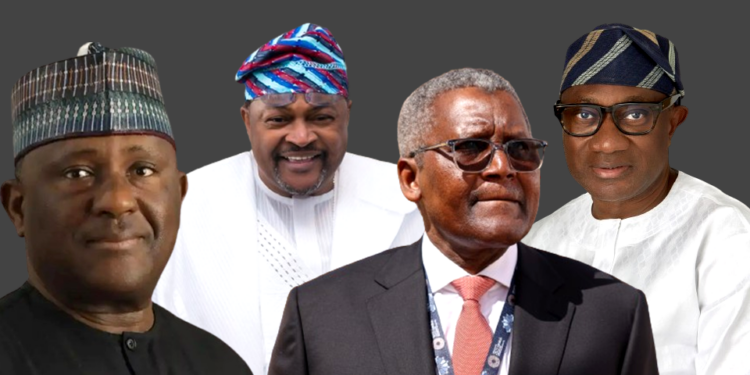
The latest list shows Africa’s billionaire class expanding their fortunes significantly over the past year, with Nigeria showing strong presence; Abdulsamad Rabiu, Mike Adenuga and Femi Otedola also made the cut as the continent’s wealthiest business leaders.
Top Society reports that across the continent, billionaire fortunes were boosted by strong equity market performance, record corporate profits, and improving currency stability in several African economies.
South Africa remains the country with the highest number of billionaires on the list, with seven individuals, followed by Egypt with five, Nigeria with four, and Morocco with three.
The Forbes ranking released on Monday shows that Africa’s billionaires have seen their wealth surge, with the continent’s 23-member “three-comma club” now worth a combined $126.7 billion, up 21 per cent from 2025.
Collectively, they added $20.3 billion to their net worth over the past year, driven by rising equity markets and stabilising regional currencies.
Dangote remains the richest African, with an estimated net worth of $28.5 billion, up $4.6 billion this year. Dangote Cement’s shares have jumped nearly 69% since last March, after the company doubled its profits in 2025 to a record one trillion naira.
Dangote recently announced a $400 million deal with a Chinese machinery company to accelerate plans to double the refinery’s full capacity by 2029.
The biggest gainer was Rabiu, whose fortune rose 120 per cent —$6.1 billion—to $11.2 billion.
Rabiu is now Africa’s third-richest billionaire, up from sixth last year, trailing South African luxury goods tycoon Johann Rupert ($16.1 billion).
Shares of Rabiu’s BUA Cement rose 135 per cent outperforming the Nigerian Stock Exchange’s 81 per cent gain.
South African billionaire Michiel Le Roux, founder of Capitec Bank, also saw significant gains as shares of the Johannesburg-listed financial institution rose 57 per cent, surpassing the 45 per cent rise of the local exchange.
The only billionaire who broke even this year is Nassef Sawiris of Egypt, valued at $9.6 billion.
He owns stakes in English Premier League club Aston Villa and sportswear giant Adidas, where he is set to become chairman in May.
Meanwhile, four African billionaires lost wealth over the past year.
Morocco’s Anas Sefrioui lost $300 million after shares of Group Addoha fell more than 30 per cent, while Nigeria’s Femi Otedola shedded $200 million but still returned to the list after selling most of his stake in Geregu Power. Both are now worth $1.3 billion.
On the collective growth, Forbes noted, “The members of the continent’s three-comma club—which surpassed $100 billion in combined wealth for the first time last year—are richer than ever, having added a collective $20.3 billion to their combined fortunes as major equity markets across the continent rally and regional currencies stabilise. In all, these 23 dealmakers and moguls are worth $126.7 billion, up 21 per cent from 2025.”
Of the 23 billionaires, 14 (61%) are self-made, with no women on the list.
All except Tanzania’s Mohammed Dewji (50) are over 60. South Africa leads the continent with seven billionaires, followed by Egypt (five), Nigeria (four) and Morocco (three).
Forbes tracks African billionaires who reside in Africa or conduct their primary business there, excluding several high-profile figures such as Mo Ibrahim, Ivan Glasenberg, Clive Calder and Elon Musk, who operate primarily outside the continent.
Net worths were calculated using stock prices and currency exchange rates as of March 1, 2026, compared with Forbes’ 2025 Billionaires list. Privately held businesses were valued using revenue and profit estimates with comparable public company ratios.

