




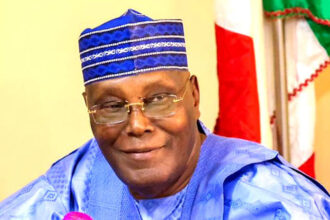


The latest exchange between Atiku Abubakar and Nyesom Wike is less of a surprise and more of a continuation of a long-running political undercurrent that has refused to settle since the aftermath of the 2023 elections.
Atiku’s recent reaction, delivered through his political circle and reinforced in carefully worded remarks, did not carry the tone of open confrontation. Instead, it leaned toward a controlled rebuttal one that appeared designed to correct narratives rather than ignite a fresh round of insults. His message, in essence, pushed back against what he sees as recurring attempts to diminish his political standing through repeated public criticism.
Without naming every point raised from Wike’s camp, Atiku’s response focused on the broader picture: his political record, his role in national opposition politics, and what his allies describe as consistent engagement in Nigeria’s democratic development.
The framing was intentional less emotional reaction, more political positioning.
On the other side, Wike has maintained his familiar style of blunt political commentary, often mixing governance, party politics, and personal conviction in a way that keeps him constantly in the spotlight. His stance since the split within the PDP after the presidential primaries has continued to shape how he engages both allies and opponents, especially figures like Atiku, who remain central to the party’s opposition structure.
What makes this latest exchange stand out is not the content alone, but the timing. Nigeria’s political environment is slowly tightening ahead of the next election cycle, and early signals of alignment and rivalry are already resurfacing. In that context, even familiar disagreements begin to carry renewed weight.
Inside political circles, Atiku’s response is being interpreted as a calculated effort to avoid being drawn into a cycle of personal back-and-forth exchanges. Rather than amplifying the friction, his approach suggests a preference for maintaining political distance while still asserting relevance within the national conversation.
Meanwhile, Wike’s continued criticisms reflect his broader political posture since his fallout with sections of the PDP leadership. His influence remains significant, especially given his role in governance and his strong base in Rivers State politics. That combination keeps his voice prominent, even when it conflicts with former allies.
The underlying tension between both figures is also a reflection of deeper fractures within the opposition landscape. What began as internal disagreement over party direction has gradually evolved into a wider contest of influence, loyalty, and political identity.
Yet beneath the noise, there is also a familiar reality in Nigerian politics: today’s public disagreement does not always equal permanent division. Alliances are often fluid, shaped as much by strategy as by ideology. This is why even sharp exchanges are frequently measured, leaving room for future recalibration.
For now, Atiku’s response signals restraint rather than escalation. It is a reminder that while political tempers may rise publicly, the real calculations often happen behind the scenes where positioning for the next political phase is already underway.
What is unfolding between Atiku and Wike is not just a clash of personalities, but a reflection of the shifting power map within Nigeria’s political opposition, one that is still very much in motion.

