




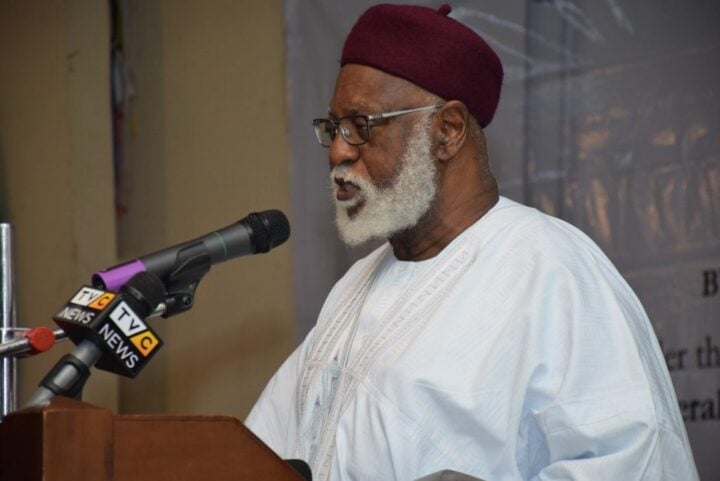
Nigeria’s last Head of State, Abdulsalami Abubakar, has canvassed the removal of military decrees embedded in Nigeria’s Constitution to strengthen the country’s democracy.
The retired army general, whose administration promulgated the 1999 Constitution, acknowledged claims that some military decrees made it to the document. He, however, urged the government to amend or remove such provisions through democratic processes to sync with democratic principles.
Abdulsalami, who made this call in his autobiography, “Call of Duty,” launched last Saturday in Abuja, wrote that “democracy is always in motion. Every day, new laws are made to reflect the needs of the people.
“If the argument is that it is a “military” constitution because it was promulgated with military decrees, we are now in a democracy and whatever changes need to be made should be made democratically and in line with laid-down procedures. There’s no perfect constitution in the world,” he added
Abdulsalami became Nigeria’s Head of State in June 1998 after the death of Sani Abacha, who had ruled the country from 1993 until his death in 1998.
Less than a year after assuming office, he successfully supervised a transition programme that culminated in the handover of power to former President Olusegun Obasanjo on May 29, 1999.
The transition ushered in Nigeria’s current democratic dispensation, which unlike the previous republics has been uninterrupted ever since.
Some Nigerians have criticised some provisions of the 1999 Constitution, which has been in use since the country’s return to democratic rule that year, for not being the people’s constitution as claimed.
Since 1999, the National Assembly has amended the Grundnorm five times, though some items proposed for amendment didn’t see the light of day as they were thrown out at the state assembly level.

