



Aliko Dangote stands as one of the most influential entrepreneurs not only in Nigeria but across Africa.
His journey from a young trader to the founder of a vast industrial empire is a story of vision, persistence, and calculated risk-taking.
Long before discussions of setbacks and failed ventures, Dangote had already built a legacy defined by bold achievements that reshaped industries and contributed significantly to economic development.
Dangote began his business career in the late 1970s, trading commodities such as sugar, rice, and cement.
With a keen understanding of market demand and supply gaps in Nigeria, he gradually expanded his operations, laying the foundation for what would later become the Dangote Group.
His early success was rooted in importation, but unlike many traders of his time, Dangote had a long-term vision to move from trading into large-scale local production.
This shift marked a turning point not just for his business, but for Nigeria’s industrial landscape. Dangote invested heavily in manufacturing, particularly in cement production.
Through Dangote Cement, he built one of the largest cement-producing companies in Africa, with operations spanning multiple countries.
Today, Dangote Cement has transformed Nigeria from one of the world’s largest importers of cement into a net exporter, saving the country billions in foreign exchange and creating thousands of jobs.
Beyond cement, Dangote expanded aggressively into sugar refining. Dangote Sugar Refinery became a dominant force in the sector, supplying a significant portion of Nigeria’s sugar demand.
His backward integration strategy investing in local sugar production was aimed at reducing dependence on imports and strengthening domestic agriculture.
Similarly, NASCON Allied Industries under his group grew into a major supplier of salt and seasoning products, further consolidating his presence in the fast-moving consumer goods sector.
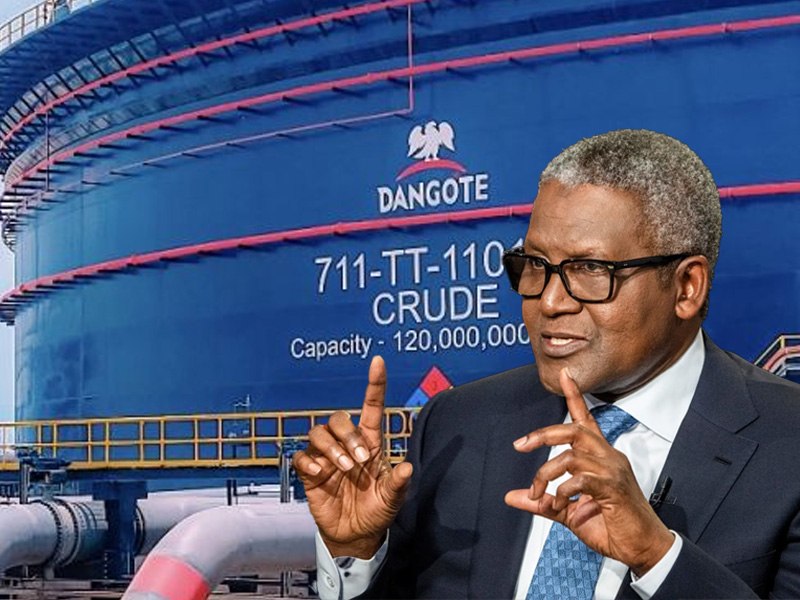
One of Dangote’s most ambitious and defining achievements is the Dangote Refinery, located in the Lekki Free Zone.
This multi-billion-dollar project is one of the largest single-train refineries in the world. Designed to refine hundreds of thousands of barrels of crude oil daily, the refinery is expected to significantly reduce Nigeria’s reliance on imported petroleum products, strengthen energy security, and position the country as a major exporter of refined fuels.
The scale and ambition of this project underscore Dangote’s long-standing commitment to industrialization and economic self-sufficiency.
In addition to oil refining, Dangote has made major investments in fertilizers through the Dangote Fertilizer Limited. His fertilizer plant is one of the largest in Africa and plays a crucial role in boosting agricultural productivity by making fertilizers more accessible to farmers.
This aligns with his broader strategy of supporting food security and reducing import dependency.
Dangote’s influence extends beyond business into philanthropy. Through the Aliko Dangote Foundation, he has funded numerous initiatives in health, education, and poverty alleviation.
The foundation has contributed to disaster relief efforts, supported vaccination campaigns, and invested in programs aimed at improving livelihoods across Nigeria and other African countries.
His philanthropic efforts have reinforced his reputation as not just a businessman, but a nation-builder.
Over the years, Dangote has received numerous accolades and recognitions globally. He has consistently ranked among the richest individuals in Africa and has been listed multiple times in global wealth rankings by Forbes.
However, beyond wealth, his true impact lies in his role in shaping industries, creating employment, and inspiring a new generation of African entrepreneurs.
Despite these monumental achievements, Dangote’s journey has not been without challenges. Like many entrepreneurs operating at scale, he has experienced setbacks across different sectors experiences that highlight the complexities of doing business in emerging markets.
Among his earlier ventures was Dangote Airline, which struggled shortly after its launch due to operational and regulatory challenges.
Similarly, Dangote Telecoms represented an ambitious attempt to enter Nigeria’s telecommunications space at an early stage, but the venture failed to gain traction in a rapidly evolving and capital-intensive industry.
In manufacturing, Dangote Textiles faced severe headwinds. Once a promising venture, it ultimately succumbed to stiff competition, particularly from the influx of cheaper smuggled textiles from Asia.
This not only affected Dangote’s operations but also reflected broader challenges within Nigeria’s textile industry at the time.
His ventures in agro-processing, including Dansa Juice and Dangote Tomato Paste, also encountered difficulties.
These challenges were tied to supply chain inefficiencies, inconsistent raw material supply, and broader structural issues within the agricultural sector.
The Dangote Tourist Resort was another project that struggled, largely due to infrastructure deficits such as poor road networks and unreliable power supply persistent issues that have historically affected Nigeria’s hospitality sector.
One of the more notable corporate challenges involved Dangote Flour Mills. Established in 1999, the company experienced rapid growth and was listed on the Nigerian Stock Exchange in 2008.
However, increasing competition and operational challenges weakened its performance over time.
Dangote sold a controlling stake to Tiger Brands for nearly $200 million, but the acquisition turned problematic, resulting in significant losses for the South African firm.
Dangote later repurchased the struggling business at a much lower valuation before eventually selling it to Olam Group.
Dangote Noodles, once produced under Dangote Flour Mills, was eventually sold to Dufil Prima Foods in 2017, marking another exit from a competitive segment dominated by strong established players.
Earlier in his career, Dangote also founded Liberty Bank, which he later sold to a group of investors led by Victor Odili.
The proceeds from the sale were used to settle obligations related to his textile business, reflecting the interconnected nature of his ventures.
What sets Dangote apart is not the absence of failure, but his response to it. Each setback became a learning experience that informed his future investments and strategies.
Rather than retreat, he doubled down on sectors where he saw long-term potentialcement, energy, and agricultureand executed with scale and precision.
Today, his empire continues to expand, and his long-term vision remains focused on industrializing Africa and reducing reliance on imports. His story underscores a powerful lesson: success is rarely linear.
It is built on resilience, adaptability, and the willingness to take risks even in the face of uncertainty.
Aliko Dangote’s journey is, therefore, not just a tale of wealth creation, but a blueprint for enduring entrepreneurshipone that demonstrates that failures are not endpoints, but stepping stones toward greater achievements.

