




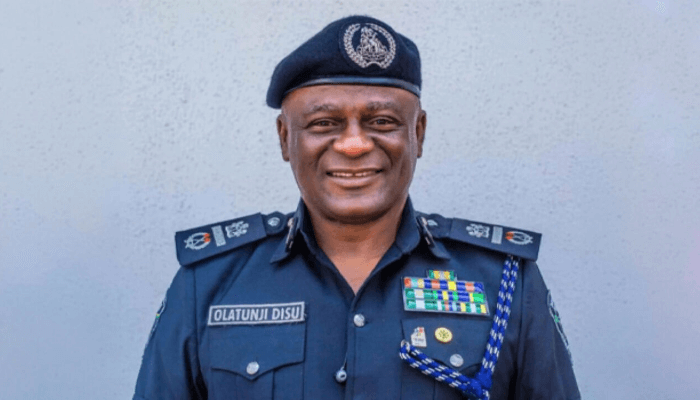
President Bola Ahmed Tinubu on Tuesday approved the appointment of the Assistant Inspector-General of Police, AIG Tunji Disu, as the Acting Inspector-General of Police (IGP) with immediate effect, according to a statement issued by Bayo Onanuga, Special Adviser to the President on Information and Strategy.
But unlike the usual practice where the press release announcing such an appointment offers snippets of the incoming official’s profile, the closest to this was “The President is confident that AIG Disu’s experience, operational depth, and demonstrated leadership capacity will provide steady and focused direction for the Nigeria Police Force during this critical period.”
Disu’s elevation to the apex position of the Nigeria Police Force (NPF) marked the culmination of over 30 years of operational, intelligence and administrative service.
Who is Tunji Disu?
The newly appointed Inspector-General of Police was born Olatunji Rilwan Disu, popularly known as Tunji Disu, on 13 April 1966 in Lagos Island, Lagos State. Although an earlier report once suggested he was born on April 17, 1960, that claim was officially debunked by police authorities, reaffirming his correct date of birth as April 13, 1966.
Disu’s formative years were shaped by a disciplined academic background. He began his primary education at Holy Cross Cathedral Primary School and later completed it at Mayflower Junior School in Ikenne, Ogun State, in 1979.
He gained admission into Lagos State University, graduating in 1990 with a Bachelor’s degree in English Education. He obtained a Postgraduate Diploma in International Relations and Strategic Studies from the same institution and later earned two master’s degrees, one in Public Administration from Adekunle Ajasin University in 2010 and another in Criminology, Security and Legal Psychology from Lagos State University in 2022.
Disu is a member of several professional bodies, including the International Association of Chiefs of Police, the Nigerian Institute of Public Relations, the Chartered Institute of Personnel Management, the International Institute of Certified Forensics Investigation Professionals, the International Academy of Forensics and the National Association of Investigative Specialists in the United States.
Disu’s Trajectory in the Nigeria Police
Disu enlisted in the Nigeria Police Force on May 18, 1992, beginning a career that would take him across multiple states and strategic units. He served as Divisional Police Officer in Ago Iwoye in Ogun State, Ikare and Owo in Ondo State, and later in Elimbu and Elelenwo in Rivers State.
These early postings grounded him in grassroots policing and exposed him to the complexities of local crime management, community relations and internal security operations.
His operational profile expanded significantly when he took on assignments within the Special Anti-Robbery Squad (SARS) and anti-kidnapping units, particularly in Rivers State. Disu served as SARS Commander in Ondo, Oyo and Rivers States and also as Second-in-Command of the State Criminal Investigations Department in Rivers.
His tenure in these high-pressure units positioned him at the centre of crime suppression efforts during periods marked by armed robbery, kidnapping and organized criminal activity.
In 2005, the new acting inspector-general of police led the first-ever Nigerian Police contingent to the African Union Mission in Sudan as contingent commander.
During the peacekeeping operation in Darfur, he was appointed Acting Chief of Staff, a role that broadened his exposure to multinational security coordination and conflict-area policing before his return to Nigeria in 2006.
One of his most publicly visible roles came when he was appointed Commander of the Lagos State Rapid Response Squad (RRS) on June 13, 2015.
Between 2015 and August 2021, Disu reshaped the identity of the RRS, branding his officers as “The Good Guys” in an effort to promote professionalism, restraint and citizen-friendly policing.
Under his leadership, the squad adopted crime mapping and hotspot policing strategies that ensured visible patrol deployments across Lagos.
Officers received training in first aid and CPR, reinforcing a service-oriented dimension to their work.
Reports during his tenure highlighted instances of officers assisting stranded motorists, supporting accident victims and, during the COVID-19 lockdown in 2020, conveying a woman in labour to hospital.
During the #EndSARS protests, it was reported that ambulances under his command were made available to provide medical assistance to protesters.
His approach during this period reflected an attempt to align operational enforcement with public trust-building.
Following his RRS command, Disu was appointed Deputy Commissioner of Police in charge of the Department of Operations at Force Headquarters, Abuja. On August 2, 2021, under Inspector General Usman Alkali Baba, he was named head of the Intelligence Response Team, succeeding Abba Kyari.
As leader of the Force Intelligence Bureau–Intelligence Response Team, he oversaw intelligence-driven operations targeting organized crime networks, including fraud syndicates accused of breaching bank accounts belonging to individuals and corporate entities. In March 2023, he was promoted to the rank of Commissioner of Police by the Police Service Commission.
Disu later served as Commissioner of Police in Rivers State before being deployed to the Federal Capital Territory, Abuja, where he assumed office as Commissioner of Police.
He also served as Principal Staff Officer to the Acting Inspector General and held strategic administrative responsibilities that deepened his experience at the highest levels of police management.
Expectations from the New Sheriff in Town
As Acting IGP, Disu steps into leadership at a time when internal security challenges, institutional reform demands and public expectations for accountability remain prominent national issues.
He would need to boost the morale of the rank and file of the Nigeria Police Force. Nigerians expect a leadership that would strengthen internal discipline within the Force and reinforces respect for human rights.
There is also heightened public concern around how the police manage protests and public dissent, with expectations that operations will reflect civility, restraint, respect for constitutional rights and adherence to the rule of law.
Many also expect a balance between enforcement of cybercrime regulations and the protection of press freedom. With the 2027 general elections drawing closer, preparations for credible and impartial election security will form another major test of the new police leadership.
This is without overlooking the major security threat in the country, including terrorism, banditry, kidnapping, cyber and organised crimes.
As a leader who combines operational experience with a commitment to professionalism, accountability, and modern policing strategies, it is expected that Tunji Disu will live up to these expectations.

